
UK backs new Essex Valley agro-processing facility to boost Jamaica’s food security

/ Our Today
administrator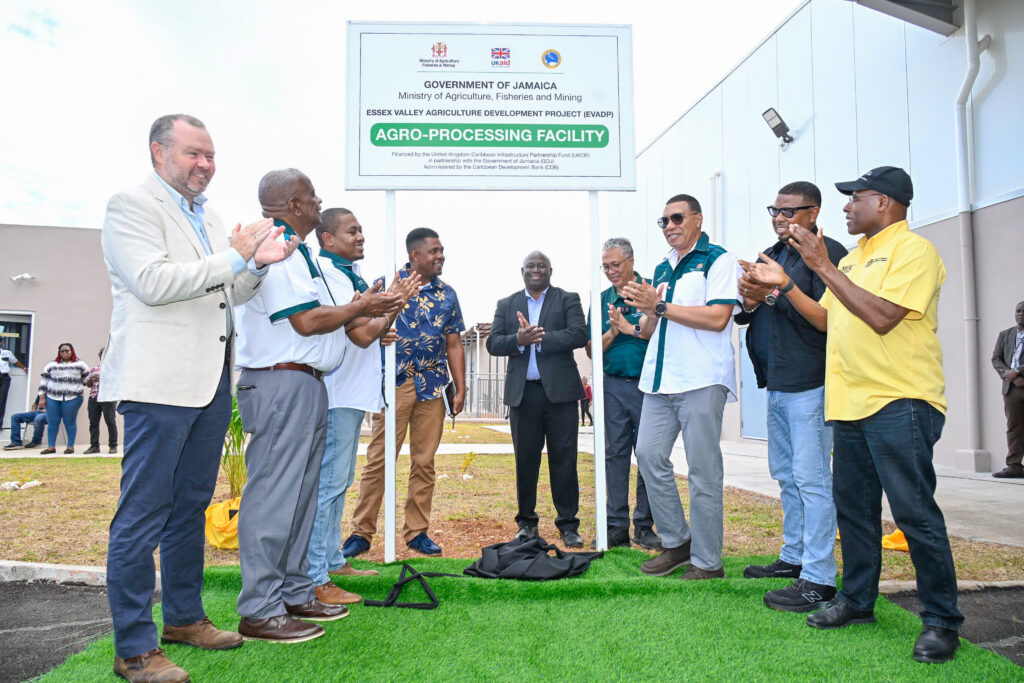
The UK Government has invested J$7.57 billion in a new state-of-the-art agro-processing Facility and Administrative Building, officially opened on Wednesday, February 4, in Essex Valley, St Elizabeth.
The project aims to strengthen Jamaica’s food security, climate resilience, and agricultural productivity.
The ceremony was attended by Prime Minister Andrew Holness, Minister of Agriculture, Fisheries & Mining Floyd Green, representatives of the Caribbean Development Bank (CDB), and officials from the UK Government.
Funded through the UK Caribbean Infrastructure Fund (UKCIF) and implemented by the CDB and the Government of Jamaica, the Essex Valley Agricultural Development Project is one of the UK’s largest climate-resilient agricultural investments in Jamaica. It forms part of the wider 74.68 billion UKCIF programme supporting critical Caribbean infrastructure. Jamaica has received 11.61 billion from UKCIF to date for two major agricultural projects, including Essex Valley.
The facility provides 810 hectares of irrigated farmland, 62 km of upgraded agricultural roads, solar-powered irrigation systems, and 30 food safety and sanitation facilities. It will allow farmers across Jamaica’s “breadbasket” parish, St Elizabeth, to store, process, and market produce more efficiently, improving market access and resilience against climate impacts.
Speaking at the opening, UK Development Representative Andrew Bowden highlighted the importance of climate-resilient infrastructure: “When storms come and as climate change makes them stronger, infrastructure that withstands those storms becomes part of the response, not part of the damage. It protects lives. It protects livelihoods. And it gives communities hope.”
The project also focuses on people, with more than 600 farmers trained, including women, young people, and persons with disabilities.
Prime Minister Holness praised the partnership, saying the UKCIF support made the Essex Valley project possible, while CDB’s Martin Baptiste called it a transformational investment demonstrating that sustainable, climate-resilient agriculture can anchor rural prosperity.



Comments