
OT Equity Analysis | NVIDIA: The Infrastructure of Intelligence

/ Our Today
administrator
Prepared for Our Today | Capital Markets & Investments Desk
There is a category of company that does not merely participate in a technological revolution it becomes the substrate of it. NVIDIA Corporation is the company for the age of artificial intelligence. The question facing investors in April 2026 is not whether NVIDIA’s dominance is real. The evidence is overwhelming that it is. The question is whether the stock, trading near US$201 after a violent 2026 correction from its October highs, has already priced in the next three years of that dominance or whether the market, rattled by export controls, competition fears, and macro turbulence, has handed patient capital one of the most asymmetric setups in recent memory.
NVIDIA’s fiscal year 2026 revenue reached US$215.94 billion a 65% increase over the prior year’s US$130.5 billion. Net income came in at US$120.07 billion, also up roughly 65%. For context: Apple, the world’s most valuable consumer technology company, posted approximately US$400 billion in revenue over the same period. NVIDIA is approaching Apple-scale revenue at nearly three times the growth rate. The data centre segment, which now constitutes approximately 91.5% of total sales, is the engine of everything. And with 38 Wall Street analysts holding a consensus Strong Buy rating and an average 12-month price target of US$266, implying more than 32% upside from current levels the institutional view is unambiguous.
| NVIDIA’s fiscal year 2026 revenue reached US$215.94 billion a 65% year-on-year increase. The data centre segment now constitutes 91.5% of total sales, and analysts project the company’s revenue could exceed US$370 billion in fiscal 2027. |

The Blackwell Moment
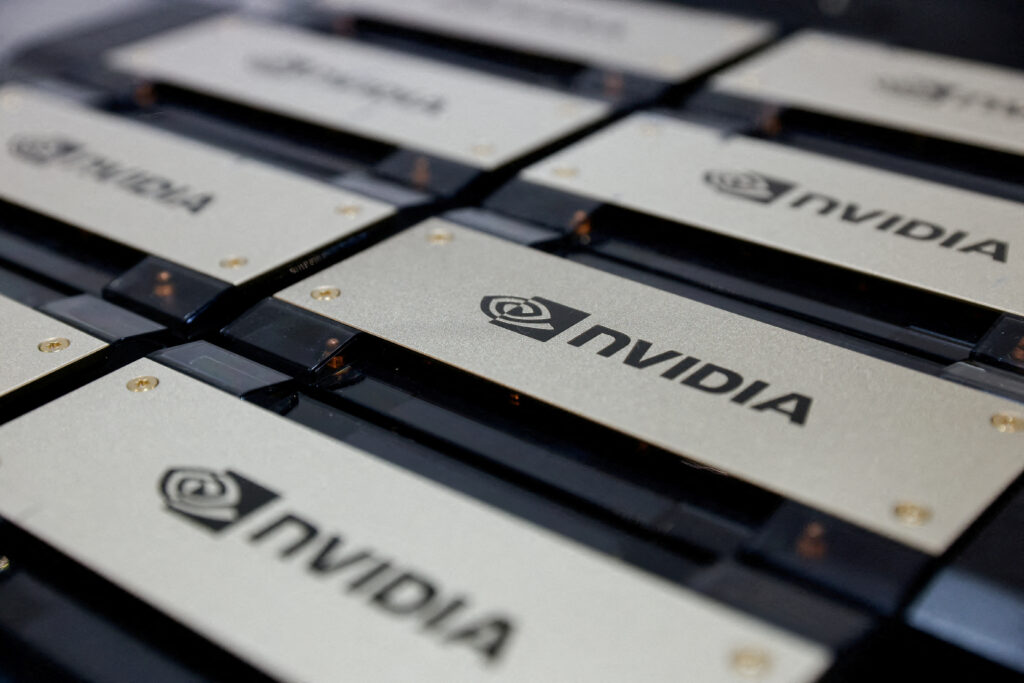
The Blackwell architecture of NVIDIA’s current generation GPU platform is not simply a faster chip. It is a rearchitecting of how large-scale AI computation is organised. Blackwell systems support multi-GPU configurations at a scale that previous generations could not, enabling the kinds of dense compute clusters that frontier AI training now demands. The transition from Hopper to Blackwell is the single most important near-term driver of NVIDIA’s revenue trajectory, and the early indications are that demand is running well ahead of supply.
The most recent quarterly earnings per share of US$1.62 beat analyst consensus of US$1.54 by 5.5%. NVIDIA’s next earnings release is scheduled for May 20, 2026 less than four weeks away with consensus estimates projecting EPS of US$1.74 for the current quarter. If Blackwell shipment volumes continue to exceed expectations, a beat of similar or greater magnitude is plausible. That earnings date is the single most important near-term catalyst for the stock.
| KEY STAT | NVIDIA’s Q4 FY2026 EPS of $1.62 beat estimates of $1.54 by 5.5%. With next earnings on May 20, 2026, and consensus projecting $1.74 EPS for Q1 FY2027, another beat on the back of Blackwell demand would be a significant positive catalyst for the stock. |
The China Problem Is Real And Priced In
The bear case for NVIDIA begins in Washington. US export controls have effectively foreclosed NVIDIA from competing in China’s data centre computing market with its most advanced products. NVIDIA’s own 10-K filing for fiscal year 2026 acknowledged the position plainly: the company is unable to create a product for China’s data centre market that receives approval from both the US government and Chinese regulators simultaneously. China once accounted for at least one-fifth of NVIDIA’s data centre revenue. That market has been partially lost.
The H200 saga illustrates the complexity. Washington authorised H200 exports to China under tight conditions each unit must be manufactured by TSMC, shipped to the US for inspection, and then re-exported. As of NVIDIA’s most recent earnings, CFO Colette Kress confirmed the company has yet to generate any revenue from those approved sales, adding that it does not know whether imports into China will ultimately be permitted. Huawei’s Ascend series of domestically produced AI accelerators has made significant progress in the interim, narrowing NVIDIA’s advantage in tightly optimised domestic Chinese deployments.
However, the China story is more nuanced than the headlines suggest. ByteDance, one of the world’s largest AI consumers, has reportedly secured access to a 36,000-unit Blackwell GPU cluster through a Malaysia-based cloud operator a deal NVIDIA confirmed is compliant with US export rules. The architecture of the new export framework may allow NVIDIA to capture significant Chinese AI demand through third-country intermediaries, partially recouping what direct sales have lost. The market has largely priced in the direct China loss. It has not fully priced in the indirect recovery.
| NVIDIA’s own 10-K is unusually direct: export controls have effectively foreclosed the company from competing in China’s data centre market. That risk is real. But the market has spent most of 2026 pricing that fear while the rest of the world builds NVIDIA-powered infrastructure at a pace that makes the China loss look like a rounding error. |
The Competition Question
No analysis of NVIDIA in 2026 is complete without addressing the competitive landscape. Custom silicon from Google, Amazon, and Microsoft alongside AMD’s MI-series accelerators has created a credible alternative ecosystem. Marvell is hitting record highs on reports of a collaboration with Alphabet to develop custom AI chips. The semiconductor rally that once belonged almost exclusively to NVIDIA is now lifting a broader field of competitors. The market has noticed.
And yet, NVIDIA’s moat is not primarily about the hardware. It is about CUDA the software programming model that NVIDIA has spent fifteen years embedding into every AI framework, research pipeline, and production deployment in the industry. Switching from NVIDIA to an alternative accelerator is not a hardware decision. It is a software migration of enormous complexity, affecting every layer of the AI stack from training frameworks to inference runtimes. That switching cost is NVIDIA’s deepest competitive advantage, and it compounds with every additional year of CUDA ecosystem development.
The competitive risk is real over a five to ten year horizon as alternatives mature. It is not a near-term earnings threat. The companies building competitive chips today will take years to accumulate the developer ecosystem depth that makes CUDA so durable. In the meantime, NVIDIA’s data centre revenue is projected to sustain a compound annual growth rate of 80 to 90% through calendar years 2026 and 2027.

Four Things to Watch
First: May 20 earnings: The market expects US$1.74 EPS. A beat driven by Blackwell shipment acceleration would be a powerful signal that the supply chain has cleared its early bottlenecks and that hyperscaler demand is translating into booked revenue at the pace analysts project.
Second: The China export framework evolution: Any formal clarification of the rules governing third-country cloud access which would effectively allow entities like ByteDance to legally access Blackwell compute through intermediaries, would significantly re-rate the China revenue recovery story. Conversely, further tightening of the framework would add pressure.
Third: Rubin architecture timeline: NVIDIA’s next-generation Rubin GPU platform is currently restricted from export to China alongside Blackwell. Any leak of Rubin specifications or launch timeline announcements will reset expectations for the next upgrade cycle and the associated revenue step-change.
Fourth: Hyperscaler capital expenditure guidance: Microsoft, Google, Amazon, and Meta are collectively spending hundreds of billions of dollars on AI infrastructure annually. Their quarterly earnings calls are effectively forward order books for NVIDIA. Any upward revision to hyperscaler capex guidance is a direct tailwind for NVIDIA’s revenue outlook.

The Verdict: The Stock the World Is Being Built On
NVIDIA at US$201 is not cheap. At a market capitalisation near US$4.9 trillion, it is one of the most valuable companies in human history. The valuation demands that the AI infrastructure buildout continues at near-current pace, that Blackwell delivers on its revenue potential, and that no competitor materially disrupts the CUDA ecosystem within the next 24 months. Those are not safe assumptions. They are, however, well-supported by current evidence.
For Caribbean investors and institutional allocators across the emerging market diaspora monitoring US equity exposure, NVIDIA sits at the intersection of every structural technology trend that will define the next decade: AI training, inference at scale, autonomous systems, and the physical build-out of digital infrastructure. The 52-week range of approximately US$88 to US$211 tells the story of the volatility that comes with this position. The correction from October 2025 highs to the March 2026 low near US$164 offered the kind of entry point that long-term holders will look back on with clarity. The recovery toward US$200 suggests the market has worked through the worst of its fear.
NVIDIA is not a bet on a company. It is a bet on the proposition that the world will continue to spend, at an accelerating scale, on the infrastructure of intelligence. The evidence for that proposition has never been stronger. The question, as it almost always is with NVIDIA, is whether you have the patience to hold through the noise long enough to be right.






Comments