
AI agents forecast Jamaica’s next government in knife-edge election?

/ Our Today
administrator
For the first time in Jamaica’s and the Caribbean’s history, a panel of advanced artificial intelligence (AI) systems has been convened to forecast the outcome of a national election.
Section 9, an independent research lab led by Jamaican AI expert Adrian Dunkley, developed a cutting-edge AI system powered by the leading LLMs (large language models), each with its distinct reasoning styles, to form a ‘Council of AI Agents’.
The council was tasked with autonomously forecasting Jamaica’s 2025 General Election, scheduled for September 3. What emerged was not a simple winner’s call, but a dramatic portrait of division, volatility, and caution.
This is the first time the Caribbean will see artificial intelligence used beyond number crunching, but to argue, debate and weigh in on the future of regional democracy.
One tight, one wide
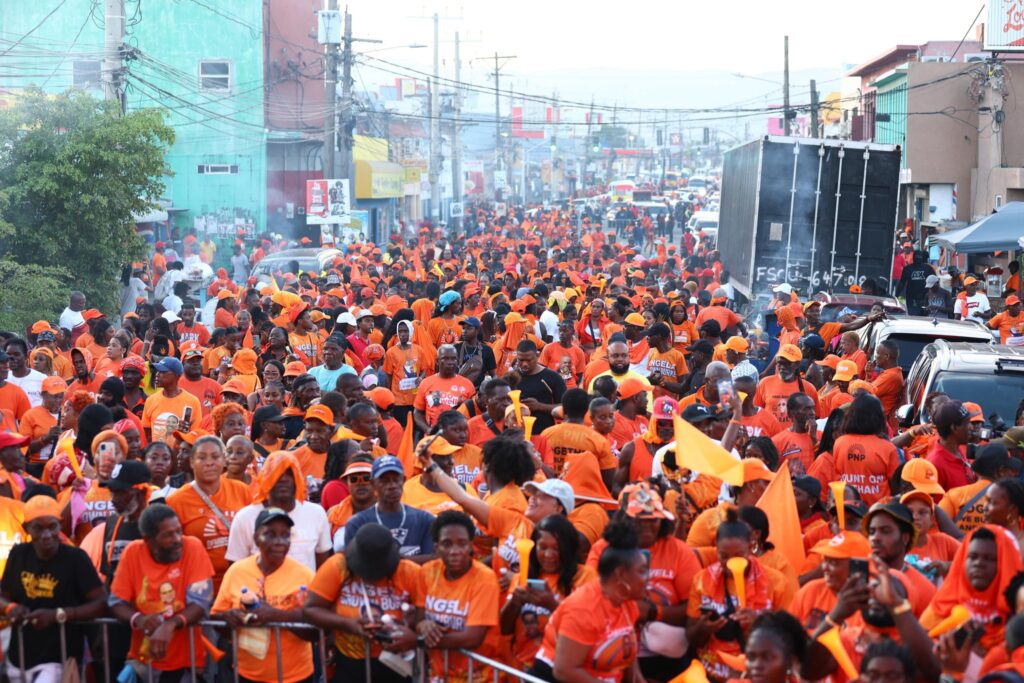
The opposition People’s National Party (PNP) support is steady enough to press in many areas, while the governing Jamaica Labour Party’s (JLP) wider spread means they have more ground to defend.

The chart above is a boxplot showing where the AI forecasts mostly landed, with the coloured boxes marking the middle spread of the data, showing where the bulk of values sit. The lines on each side show the few results that fell further out.
The PNP’s voter forecasts exhibited greater convergence, with agents estimating support within a relatively narrow band of 47.0 to 50.5 per cent, centring around a midpoint of 48.9 per cent.
This consistency arose from the alignment of multiple models detecting similar directional forces in the electorate. Commonly identified signals helping the PNP included economic strain on two household earnings and savings, widespread frustration with public service delivery, and heightened concern over crime and corruption. These factors provided undecided or soft-aligned voters with a clear psychological nudge toward change, favouring the PNP. As a result, despite differences in the AI agents’ methods, they repeatedly arrived at forecasts within the same range, reinforcing the robustness of the signals.
Forecasts for the JLP displayed greater dispersion, with projected support ranging from approximately 46.5 to 52.0 per cent and a central estimate near 49.4 per cent. This wider spread reflects the greater dependence of JLP’s performance on tactical execution rather than prevailing sentiment.
The governing party’s outcome is highly sensitive to operational variables such as turnout mobilisation, the strength of constituency-level machinery and performance in a small subset of competitive seats. When this ground operation is activated effectively, JLP can secure a narrow advantage, even if national sentiment appears evenly split.
Conversely, a lapse in execution can lead to swift declines in seat share. Most AI agents linked the JLP’s performance to perceived leadership strength, historical governance track record relative to the PNP, and voter interpretation of anti-corruption narratives, which appeared fragmented across subgroups.
Both parties cluster around median support near 49 per cent, which statistically presents a level national race. However, the forecast distributions differ in shape. PNP’s curve is tighter and more stable, reflecting a broad and consistent drift toward change. JLP’s distribution is more variable, contingent on dynamic mobilisation effects. In this context, late-stage shifts such as a targeted turnout surge or message resonance in key marginals could translate into seat swings.
In an election this close, such marginal gains could be decisive. The outcome may be determined not by broad national sentiment, but by precision execution in a handful of critical constituencies.

What the AI Agent Council found
The council could not unanimously agree; five agents predicted the Jamaica Labour Party will hold on by the slimmest of margins, four said the People’s National Party will win.
Lead researcher Adrian Dunkley explained, “One of the agents essentially threw up its hands and refused to be convinced by the others; it kept saying it was too close to call and refused to choose a side. The difference is so tiny that the council itself called the race a ‘statistical dead heat’.”

Inside the debate
The agents convened a meeting to discuss their findings. Here are a few of the most striking exchanges from the council’s debate:
Claude Agent argued that the national mood was turning orange, insisting that while the PNP could take the popular vote, the JLP’s map advantage might still deliver more seats.
“This is the paradox of Jamaican politics,” he said, “the people’s will is not always reflected in the seat count.”
DeepSeek Agent dismissed that view, declaring bluntly that “mandates don’t matter, power does, and power rests on constituencies and machinery. The JLP has both.”
Gemini Agent countered with equal force, pointing to discontent over scandals and rising costs of living.
“The people crave integrity, ” the agent argued. “They are ready to punish arrogance.”
When the conversation turned to turnout, GPT4 Agent gave voice to what it called the street’s perspective: “Listen to the markets and the buses. People feel ignored. They may not love the PNP, but they’ll use their vote to send a message. GPT-5, the most clinical of the group, remained unmoved.
“Emotion motivates, but structure wins. The ruling party’s cushion holds unless there is a wave. And I see no wave.”
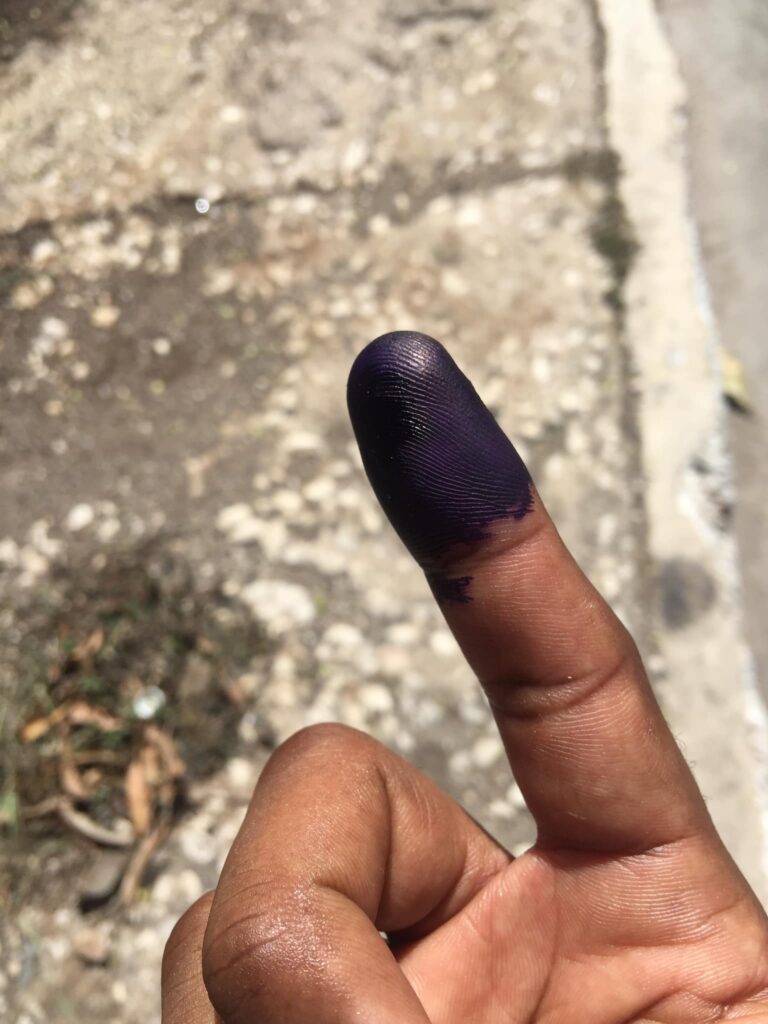
All ten agents, though, landed on one point of agreement: turnout will decide the election. If the disengaged and the young remain home, the incumbents survive. If anger translates into ballots, the opposition can sweep marginal seats.
Why this matters
Beyond the forecasts, the achievement is monumental. For the first time, Jamaica has witnessed a council of AI systems act as analysts, debaters, and interpreters of its political moment. They highlighted what is at stake: that legitimacy and power are not the same thing.
That voter apathy has become the most powerful force in our democracy. That mobilisation in the final week may matter more than any campaign promise.
As one agent put it: “This is not a wave election. This is a battle of motivation. A motivated minority will choose Jamaica’s future.”
Limitations
With days to go, the forecasts capture national trends but cannot fully reflect last-minute swings in Jamaica’s 63 constituencies. Small local shifts and turnout surges could tip seats, and real-time sentiment, especially among undecided and younger voters, remains only partly measurable. The results should be read as signals of direction.
Conclusion
The Council of AI Agents did not give us a clear winner. Five voted JLP, four voted PNP, and one refused to call it. The middle forecasts show a 0.2 per cent margin, too small to be meaningful.
But, what they did give us was something more valuable: clarity about what is at stake.
Mobilisation in the final week will decide Jamaica’s next government. Power may change hands, or it may not, but whichever party wins will face a public that is sceptical, weary, and ready to demand more.
As one agent commented, “The election is not about who has the bigger lead today. It is about who can convince Jamaicans to care enough to vote on election day.”
About this study

This study was produced by Section 9, an independent social good AI lab. Section 9 is not affiliated with any political party. The research was independently funded. To Dunkley’s knowledge, this is the first public election project in the world to use a group of AI agents. The Council of AI Agents is an experimental methodology designed to autonomously synthesise insights from multiple advanced AI systems in order to improve political forecasting, civic education, and democratic literacy.
Section 9 developed an AI agent framework called The Council of AI Agents (CO2A) powered by ten (10) leading large language models (LLMs); OpenAI’s GPT-4, GPT-4o, GPT-5, Anthropic’s Claude Opus & Claude Sonnet, Google DeepMind’s Gemini 2.5 Flash & Pro, xAI’s Grok-3 & Grok-4, and DeepSeek-V3 to forecast Jamaica’s 2025 General Election.
The goal was to test whether a council of AIs could provide a balanced forecast in a highly competitive electoral environment.





Comments