
BOJ cuts policy rate to 5.5 per cent in cautious adjustment

/ Our Today
administrator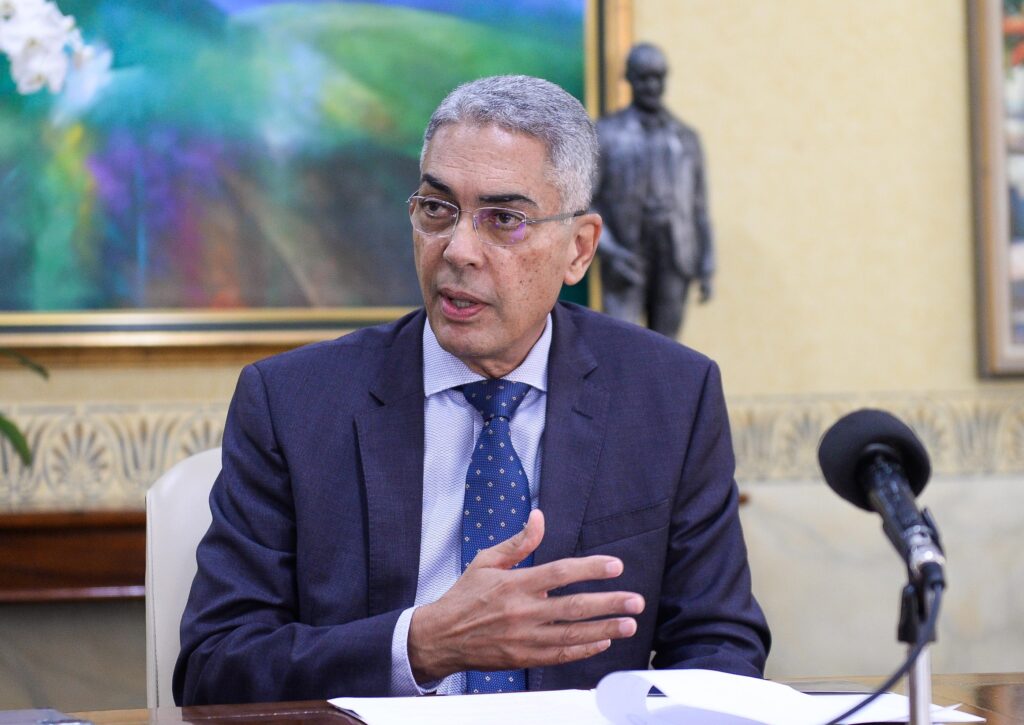
The Bank of Jamaica (BOJ) Monetary Policy Committee (MPC) has unanimously agreed to lower the policy rate on overnight placements by deposit-taking institutions by 25 basis points, bringing it to 5.5 per cent per annum.
Speaking during the Quarterly Monetary Policy Report press conference at the BOJ auditorium in downtown Kingston on Tuesday (February 24), Governor Richard Byles, said the decision to reduce the policy rate reflects a “cautious adjustment “to the monetary policy stance.
“[This] followed a detailed assessment of the most recent inflation out-turn and the near-term outlook for prices,” he explained.
The Central Bank Governor emphasised that BOJ is always guided by evidence and is prepared to adjust its policy decisions based on careful consideration of both established and emerging trends.
“Looking more closely at the recent inflation print on the 16th of February, the Statistical Institute of Jamaica (STATIN) reported that headline inflation at January 2026 was 3.9 per cent, down from 4.5 per cent at December 2025. This out-turn was below the Bank’s most recent projection and just under the lower limit of the Bank’s [four to six per cent] target range,” he said.
Byles explained that the decline in inflation compared with December 2025 largely reflected lower food prices, driven by improved farm produce supply following Hurricane Melissa in October 2025.
He noted that core inflation—excluding agricultural food and fuel from the consumer price index—also fell to 3.9 per cent in January 2026, down from 4.2 per cent in December 2025. “So, for the three months after the hurricane, STATIN recorded inflation rates within or just slightly below the lower limit of the Bank’s target range. Since August of 2024, there have been 17 consecutive months of inflation within or below the target range,” Byles said.
Meanwhile, the Governor advised that developments in the foreign exchange market have also contributed to easing price pressures in the economy.
In response to Hurricane Melissa, the Bank deployed special measures to stabilise the exchange rate as part of its broader strategy to manage inflation after the shock. Byles shared that since the hurricane’s passage, the Bank has sold approximately US$365 million into the market between November 1, 2025 and January 31, 2026.
During the same period, BOJ also sold US$87 million to Stat refinery, Petrojam, bringing cumulative sales to US$452 million. The BOJ made net purchases of approximately US$152 million during the period, November 1, 2025, to January 31, 2026, following the hurricane.
“The Bank has, therefore, delivered on that promise of foreign currency price stability. The exchange rate has appreciated since November 2025, supported by strong foreign currency inflows, reflecting improved remittances as well as the Bank’s use of its healthy reserves to augment flows in the market and the other special measures that we announced since November,” Byles said.
Cumulatively, the Bank sold US$1.1 billion via its BOJ-Foreign Exchange Intervention and Trading Tool (B-FXITT) facility in the 12 months ending January 2026, consistent with the US$1.1 billion sold in the 12 months ending January 2025. “Notwithstanding these sales, the Bank net purchased approximately US$990.5 million over the 12 months to the end of January 2026,” Byles stated, while assuring that BOJ will remain proactive in preserving relative stability in the foreign exchange market.



Comments