China hits back at Trump tariff hike, raises 84% duties on US goods

/ Our Today
administrator
BEIJING (Reuters)
China hit back at US President Donald Trump singling out the world’s second-largest economy for tariffs of more than 100 per cent by raising additional duties on American products to 84 per cent on Wednesday (April 9), deepening the trade war between the two superpowers.
Beijing also imposed restrictions on 18 US companies, mostly in defence-related industries, adding to the 60 or so American firms punished over Trump’s tariffs.
The move comes after Trump made good on his threat to impose an additional 50 per cent tariff on China unless it withdrew its retaliatory levies on the United States, taking total new US duties on Chinese goods this year to 104 per cent.
Beijing announced in response it would also raise its levies on US goods by 50 per cent, adding to the 34 per cent increase previously announced and due to be implemented on Thursday.
“The US escalation of tariffs on China is a mistake on top of a mistake, which seriously infringes [on] China’s legitimate rights and interests and seriously undermines the rules-based multilateral trading system,” China’s finance ministry said in a statement.
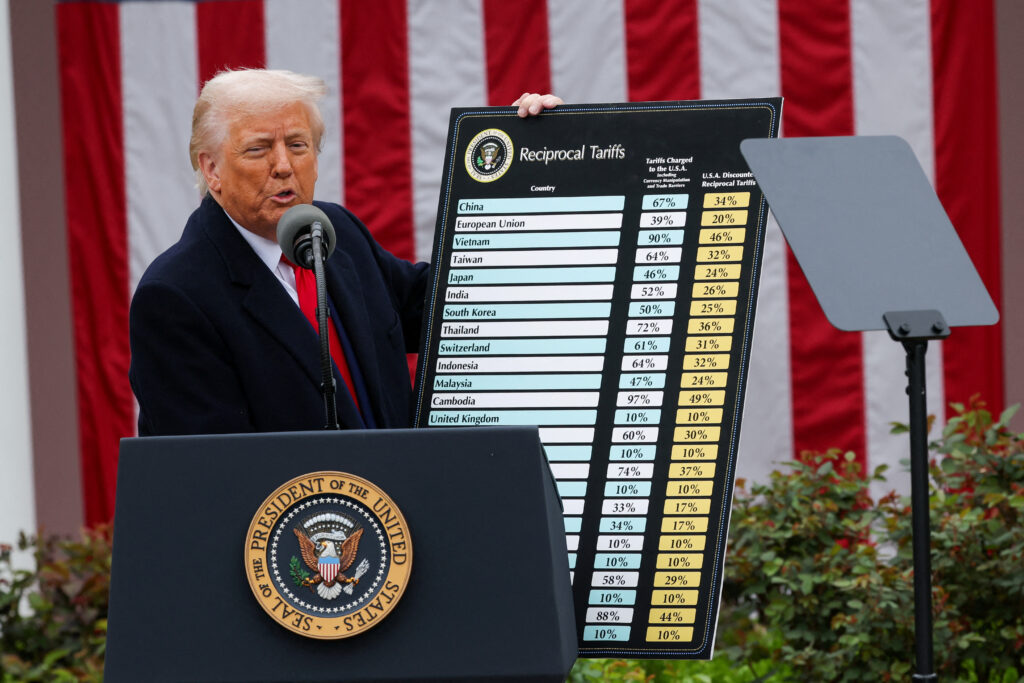
Trump has imposed “reciprocal” tariffs on dozens of economies he accuses of “ripping off” the US by selling goods into the world’s largest consumer economy while maintaining trade barriers that inhibit US firms’ market access.
But he has singled out China for the most punishing taxes, setting the stage for a standoff between the world’s top two economies.
Earlier on Wednesday, China released a white paper on US-China commercial ties in which it called the trade gap between the world’s top two economies “inevitable”.
“China does not deliberately pursue a trade surplus,” said the report, which was released by the State Council Information Office shortly after the higher US tariffs took effect.
“The trade imbalance in goods between China and the US is both an inevitable result of structural issues in the US economy and a consequence of the comparative advantages and international division of labour between the two countries,” the report added.
TRADE SURPLUS
China’s trade surplus with Washington widened to US$295.4 billion last year from US$279.1 billion in 2023, according to US Census data. The goods trade gap peaked in 2018 at US$418 billion, the same year Trump, in his first term as president, imposed tariffs on Chinese outbound shipments.
The first US-China trade war concluded with Beijing agreeing to a “Phase 1” trade deal with Washington in 2020 in which it agreed to increase purchases of US exports by US$200 billion over a two-year period.
Beijing failed to meet its targets when the COVID-19 pandemic struck, but said in its white paper that it had “scrupulously fulfilled its obligations” by taking steps to boost its purchases of U.S. goods and accused Washington of having reneged on the deal.
“The US has systematically escalated economic and other forms of pressure against China, the report said. “Concurrently, the U.S. has promoted false narratives related to human rights, Hong Kong, Taiwan, Xinjiang and the pandemic.”
China also talked up its efforts to boost its trade in services with the US, economic activity that the Trump administration has not factored into its “reciprocal” duties.

“The US stands as the largest source of China’s deficit in service trade, with the deficit generally exhibiting an upward trend,” the white paper said.
WAR OF ATTRITION
China is bracing for an economic war of attrition as it tries to court other markets in Asia, Europe and the world. But other countries have much smaller markets than America and are also taking a hit from the tariffs.
During Trump’s first term, China frustrated US financial and professional services firms by holding up licence applications and carrying out office raids.
But Beijing cannot dip into the same playbook this time as it is trying to attract fresh foreign investment to bolster its economic recovery.
Still, Chinese policymakers are backing themselves to go toe-to-toe with the Trump administration a second time.
“If the US insists on escalating trade restrictions, China has both the determination and the means to respond forcefully – and will do so,” a commerce ministry spokesperson said in a statement accompanying the white paper’s launch.
“There are no winners in a trade war. China does not want one, but the government will never allow the legitimate rights and interests of the Chinese people to be harmed or taken away.”
Ordinary Chinese people have started to voice their concerns.
“The situation has already reached a blatant financial and trade war on the global stage,” said Ling Wanhua, a 20-year-old Shanghai resident. “It’s already hard for college graduates to find jobs. If the overall environment gets worse, the employment situation for graduates will be even worse.”
Reuters reported China’s top leaders planned to convene a meeting as early as Wednesday to discuss measures to boost the economy and stabilise the capital markets.
“I think the 104 per cent tariffs are kind of exaggerated,” said Wu Lina, a 68-year-old tourist holidaying in Shanghai. “This president, the way this country treats China, oh my God, it will definitely cause some harm.”


Comments