
Despite $30.5 billion net profit NCB’s share price still remains a major talking point

Al Edwards / Our Today
administrator
There has been plenty of negative news surrounding NCB during the summer months but despite it all, unaudited results for the nine months ended June 30, 2025 saw NCB Financial Group (NCBFG) report a consolidated net profit of J$30.5 billion generated from year-to-date net operating income of J$110.2 billion, a 21 per cent increase on the same period for the prior year.
It has to be emphasised here that NCB’s financial performance for the period under review was bolstered by a one-off gain in the March quarter of $15.1 billion from the sale of a Dutch-Caribbean insurance interest. Not discounting this windfall, NCBFG points to its improved net income performance in six of its seven revenue lines.
Return on assets (annualised) increased by 1.73 per cent from 1.08 (last year), and return on equity improved from 10.34 per cent to 13.97 per cent. NCBFG now has total assets of $2.39 trillion.
Net profit attributable to stockholders came in at $19 billion, an increase of 60 per cent. However, for the June quarter, consolidated net profit declined by $9 billion, registering at $8.3 billion compared to the March quarter of 2025. Again, this was due in the main to the one-off gain.
A key strength of NCB, not just as a Jamaican financial institution but also as a regional one, is its indomitable deposits. As at June 2025, deposits stand at $806 billion, a 5 per cent increase on last year. This is NCB’s moat and gives heft to its balance sheet. At the end of the day, it’s all about customers.
NCBFG’s loans and advances, net of credit impairment losses for the period under review, were stagnant at $629 billion, just a 2 per cent increase over 2024’s figure. The local financial sector has struggled this year to generate notable income from loans. In NCB’s case, of significance is the uptick in non-performing loans, coming in at $29 billion, a 6 per cent increase over last year.
The insurance arm of NCBFG is making steady progress. For the period under review, it contributed $15.3 billion, an increase of 8 per cent or $1.1 billion over the same period in 2024. This was driven by a 36 per cent increase in the Property and Casualty insurance portfolio, which was, to some degree, offset by a decline in the life, pension and health segment.
Insurance contracts came to $562 billion, a $133.4 billion increase over the prior year. This was due to growth across the group’s product lines in both the English and Dutch-Caribbean markets.
Equity attributable to stockholders for the nine-month period was $190 billion, an increase of 16 per cent over the prior year. NCB attributed this rise to an increase in retained earnings while reducing unrealised fair value losses.
The goal, albeit a difficult one, is to contain operating expenses. It’s a beast that demands to be constantly fed. Here, NCBFG saw its operating expenses climb to $74.3 billion, an increase of $5.2 billion over the same period in 2024. NCB put this down to a 17 per cent increase in operating expenses, emanating from one-off operational losses, which grew by $ 2.6 billion, stemming primarily from its banking arm. Staff costs went up by 5 per cent.
There is plenty of talk about going digital and pivoting this way quickly, and reducing dependence on traditional banking operations. This comes at a cost, and the technology has to be constantly updated. There are so many scams and employee dishonesty occurring that financial institutions have to spend money countering them.
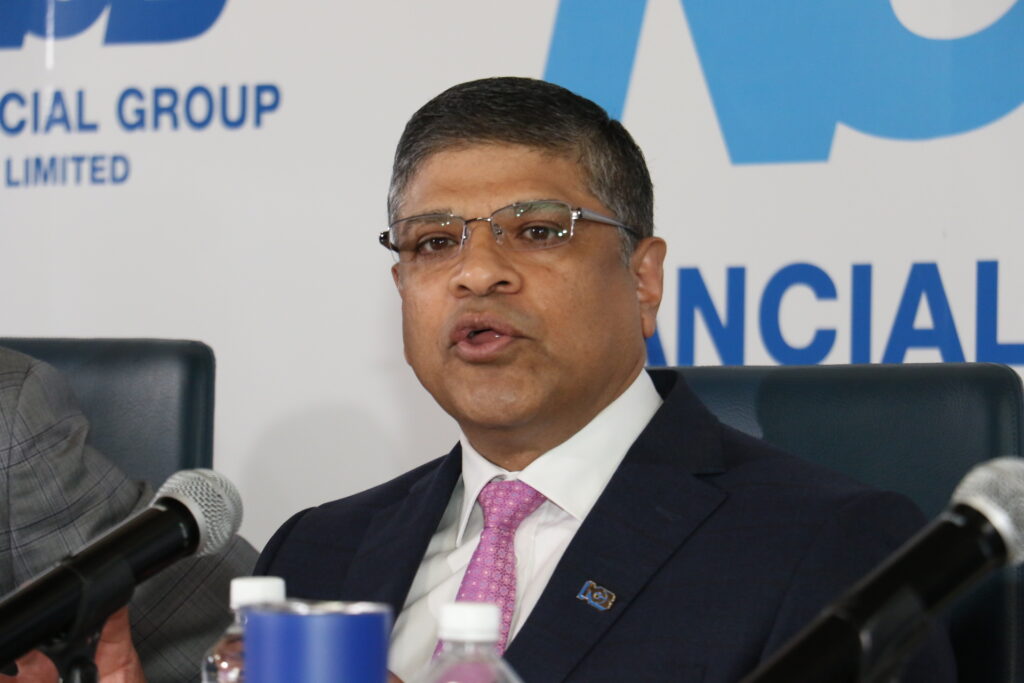
Commenting on this unaudited financial performance for the nine-month period ended June 30, 2025, NCBFG CEO Robert Almeida wrote: “Our performance continues to reflect the disciplined execution of our strategic priorities. In less than three years, since October 1, 2022, consolidated equity has increased by $101.4 billion or 73 per cent, and consolidated equity attributable to stockholders increased by $73.3 billion or 63 per cent.
“Consolidated equity of $ 240 billion increased by 21 per cent or $41.5 billion, and consolidated equity attributable to stockholders of $189.8 billion increased by $27 billion over the prior year’s June 2024 balance. This growth underscores our commitment to strengthening the Group’s capital base and delivering long-term value to our shareholders.
“This quarter’s results demonstrate effective execution across our core business lines, contributing to improved core net recurring earnings. The strategic priorities created strong momentum across our business segments, which has led to commendable revenue growth and continued margin expansion.”
Earnings Per Share ( EPS) for the period under review came in at $7.86. NCB approved an interim dividend of $0.50 per ordinary stock unit to be paid on September 05, 2025.
This creditable performance for the nine-month period did not positively impact the share price; in fact, it fell to $28.50 before recovering to $30.69.
NCB has been constantly in the press of late with reports and opinions on its share price. There are those who doubted its ability to raise a US$300 million bond on the international capital markets.
An increase in dividends would curtail much of the chatter.
The media business is not taken seriously in the Caribbean, but there are those who know just how to wield it like a stiletto. A spotlight has been turned on NCB and its lead principal, Michael Lee Chin. The media here has conjoined the fortunes of both, and that has formed the collective consciousness on this saga.
The senior management must now make a concerted effort to highlight progress made by the NCB Group, independent of its chairman, Michael Lee Chin. They must promote and champion their products and services.

Perrin Gayle, Angus Young, Malcolm Sadler, Bruce Bowen, Robert Almeida, Shree Martin, and Dr Karrian Hepburn Malcolm must be bold in trumpeting their successes. It is for them to sell the value of NCB. They must get the word out.
As it stands, there is an impression that NCB is in crisis, with talk questioning its resilience and viability.
NCB should not be a stock to be purchased because it is now a basement bargain; rather, its intrinsic value and merit as the leading financial player should be its calling card.
Efforts must be made to allay fears and reposition NCB in the public’s perception.
NCBFG Chief Financial Officer Malcolm Saddler told reporters last week, “The stock price as it is now is not indicative at all of the performance and the worth of the group.”
That being said, NCB must now show this to be the case, soothe the brows of perturbed shareholders.
Michael Lee Chin’s financial commitments should not be inextricably linked and determine the performance of NCBFG. NCB must stand on its own, and so too Guardian.
The recent raise of US$225 million allows NCB to honour commitments coming due and bolster its balance sheet. That’s a positive given that many were forecasting NCB would be unable to attract and raise funds on the international capital markets.
Can NCB show why it is the 800-pound gorilla in the room? That would go a long way in stopping people expressing dismay with its share price and pontificating about a possible sale.
NCB has been reporting good earnings over the last two years, and if it continues to do so, it should be able to climb out of turbulence into more benign skies.






Comments