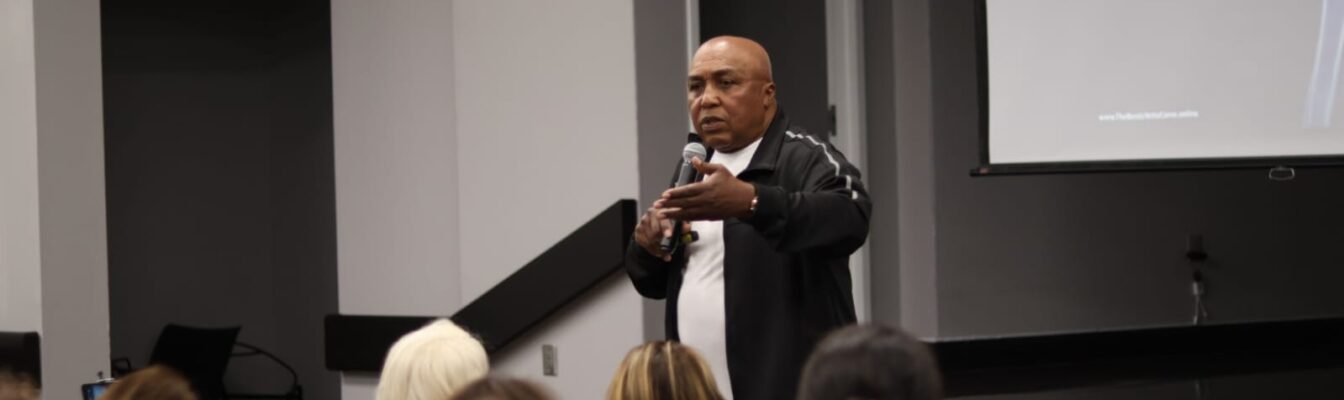
‘Don’t let Christmas get to your head’, psychologist warns

/ Our Today
administrator
Sean A Williams/Contributor
It’s that time of year when the ‘switch is flipped’, and so many people face a losing battle and plunge into a frenzy of uncontrollable excesses.
Christmas, or the mere mention of it, does something to the psyche like nothing else. Forget Baby Jesus and his storied birth, for Christmastime serves the lower but intense purpose of the almighty dollar and the merchants who exploit the season for profit.
To the consuming public, the Christmas tradition crucially embodies the proverbial good cheer, joy, and charity—feel-good emotions that celebrants chase with frenetic verve.
While the cost to achieve the irresistible Christmas haze can be high in dollars and cents, it potentially can take a heavy toll on mental health as well.
As part of the dark side of the season, there are those who tend to sink into depression because their frail financial situation does not allow them to enjoy Christmas in the traditions of the commercial demands.
Not being able to put up those Christmas lights, buy new clothes and toys for children, and afford the expensive ham as the centrepiece of the dinner table, can weigh heavily on the mind.
And it is for this reason why some adults seek out those high-interest-rate holiday loans to augment regular income so they are able to binge spend in pursuit of the “holly-jolly” spirit.

And when the feast and festivities would have fizzled, the reality of repaying those loans would hit hard. In this case, without money there is a headache, and with it, there is still a headache.
Noted Jamaican psychologist Dr Leahcim Semaj supports the view that the bright lights of Christmas bring with them the blues, not only to the income-deprived but also to the gainfully employed. Nobody escapes the trap.
“There are burdens on the fully employed [as well]…because everybody wants a little extra money so that they can splurge to facilitate those who are their dependents.
“The mental issues around depression and related concepts are real. At this time (Christmas), the persons who have nothing, some amount of depression can set in because you see all the advertisements for all the parties and all the gifts and then you realise how stark your own situation is, so this is one of the times when a certain amount of depression occurs when people see how much they don’t have,” he shared with Our Today.
“Our financial institutions will encourage people to have special savings accounts for Christmas so that you can really splurge when the time comes, and yes, many even offer special loans to facilitate you being able to get all the things that your heart desire, but then you have to confront January when the payments are due.
“But a lot of people are willing to forego this from the standpoint of ‘let me deal with that (repaying loan) when it comes; let me just get the money now so that I can enjoy myself and have a good time’,” Dr Semaj added.
A prominent life coach and motivational speaker, Dr Semaj puts an intriguing twist on the conversation that it is not only those on the lower rung of the socioeconomic ladder who feel mental and monetary pressure associated with the season.
“If you notice that in our society, there are people who are at the middle to upper end where the pressure is on them at Christmas time as well to give to all the other people below them—the helper, the gardener, the man who delivers the mail, the garbage collector; you’re expected to find extra to give these people.
“The other side of this is that people in the lower socioeconomic sector of society have an expectation of getting something at Christmas. They believe they must get something extra for Christmas. So to a large extent, this is a very transactional experience for many people, and it’s serious pressure on people in the middle class and upper class that, whatever the context, they are expected to give to all these other people around them,” he reasoned.
Dr Semaj, a management consultant, said children, to whom Christmas has the greatest appeal, are themselves exposed to psychological impacts when the parents are unable to provide the things that dazzle the eye and captivate the mind.
“The impact on children is largely a function of their socialisation, and especially what their parents and those around them do. If their parents will make it clear that ‘I’m giving you what I have, so be satisfied with what you get, then these children [will learn] to live within their means.
“But then if they hear everyone around them talking about what they have and what they need to get and so on, then they too will internalise that and have the serious feeling of deprivation.”
Dr Semaj advises parents to come straight with their children from day one as to the financial realities, so they don’t set their dependents’ expectations beyond their reach.
“It is best when parents, as soon as possible, level with the children… let them know that there is no Santa Claus, and if they want to believe in a Santa Claus, it is your mother and father who are the Santas.
“It is unfortunate that so many adults perpetuate the fantasies that they were socialised to accept as children with their own children, but you can help your children to be free of this by telling them the truth and get back to the sort of original concept about giving and sharing. These are the elements that somehow get lost by the way,” Dr Semaj said.
“It is my observation that our attitude to Christmas and the festivities and indulgences goes back to our experience of slavery and post-slavery and our colonial past because this was probably the only time where slaves got a day off. Plus, you know the festivities around it and the whole British concept of Boxing Day, whereby the leftovers from Christmas were put in boxes to be delivered and shared with the less fortunate. So, at every level of our society, it is deep in our DNA that this is the time for festivity and to celebrate as much as you can,” he added.
Dr Semaj, whose vast occupational hat also covers social philosophy, spared a thought for the worst Jamaicans going into the holidays—Hurricane Melissa victims.
He declared that the unique hardships that many people in the hardest-hit segment of the country are experiencing present a point of pivot that could reset the way Christmas is viewed and embraced going forward.

“Melissa has put a special twist on this time of the year with the feeling of relative deprivation… it is good to see that some communities are consciously providing ways and means to redefine Christmas, and I do believe some amount of celebration should be made possible because of the expectations people have, but they should sort of temper the expectations.
“It (Hurricane Melissa) is an excellent chance for us to redefine and reposition Christmas as importantly a sharing time, a time for fellowship; you cook together and share a meal and get back to that kind of basics. It can be done as we have done it before, and that is to work with exactly what you have and make the most of it,” Dr Semaj challenged.
“Whatever you can get given the circumstances, is more reason to be grateful given what you don’t have at this time… it also means that the rest of us who have not been impacted can make the time a little more pleasant for someone else, even in the most basic of ways, which will be well received.
“I see that Black River is talking about having a Christmas tree, but a scaled-down version and that the celebration in the presence of the Christmas tree is a celebration of gratitude for life, as life was spared even though buildings were lost. We can use the context to address the things that are relevant in that community, and the sharing that look ‘talk about the widow’s mite from the little that each of us has; if we find a way to share with each other, all of us can get something,” he added.
The demands of the season are felt in every fibre of the Jamaican society and Dr Semaj pointed to the usual uptick in crime that brings its own challenges.
“You will always see an increase in petty theft and robbery because there is a saying that ‘if you can’t earn it, then you will hunt it’. So, yes, there is the drive to have more to spend, so those who can’t do that in a law-abiding way will do so in whatever other way possible. So, it’s all part and parcel of the same package,” he said.
Another recognised stressor at this time is the strain on some personal relationships when there is not enough resources to go around to satisfy the needs.

“People who are in genuine relationships would have been clear what their expectations are vis-à-vis these holidays, but on the other hand, you have others who are in situationships, especially those that are largely transactional, and all kinds of strategies have evolved over the years regarding this time period.
“There are a lot of men who play the game of disappearing a couple weeks before Christmas because they don’t plan to honour the expectations of the women in their lives.
“The expectations are on both sides, so we have had situations where women who, because of the demands and the desires, especially for clothes, wigs, and jewellery, and so on, will facilitate the transaction… it is just another strange side to the reality of our relationships and situationships in Jamaica,” Dr Semaj ended.






Comments