
Douglas Martin Levermore | More than a game: hand-eye coordination and the future of work

/ Our Today
administrator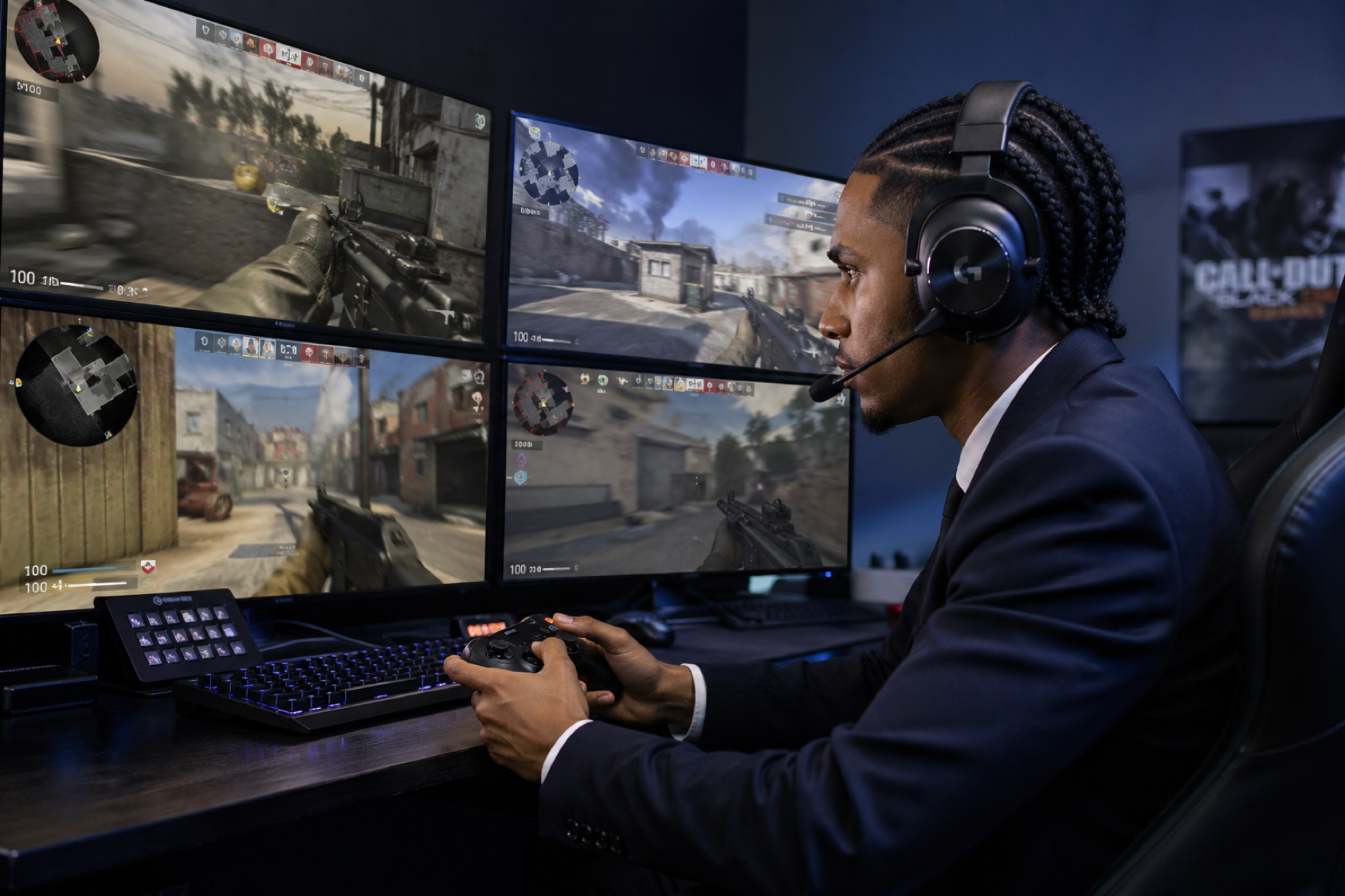
“Play is the highest form of research.” — Albert Einstein
Across the world, young persons, controllers in hand and eyes fixed intently on a screen, move their fingers with astonishing speed and precision. To the casual observer, it appears to be little more than entertainment—time spent in a virtual world detached from reality. Yet beneath that surface lies a demanding exercise in strategic thinking, concentration, coordination, spatial judgment, timing, pattern recognition, and rapid decision-making. What looks like play may, in fact, be rehearsal for a digital future.
For decades, video games have been dismissed as distractions—at best harmless diversions and, at worst, obstacles to discipline. That judgment now feels increasingly outdated. Research emerging from institutions such as the University of Rochester has shown that action video game players often demonstrate enhanced visual attention, faster reaction times, and improved hand-eye coordination. These are not marginal gains; they are precisely the capabilities that matter in a world where work is increasingly mediated through screens, interfaces, sensors, and remote systems.
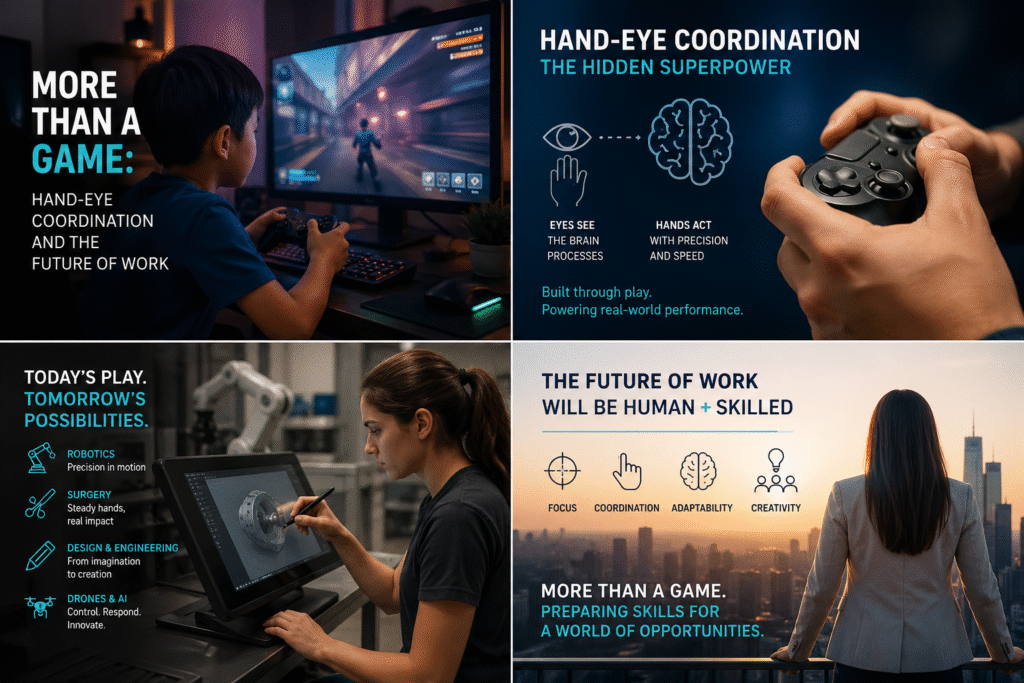
Hand–eye coordination, in particular, has taken on renewed importance. According to the National Institutes of Health, it is the coordinated control of eye movement with hand movement, enabling the processing of visual input to guide reaching, grasping, and other goal-directed actions. In a technology-driven environment, this ability is no longer confined to athletics or manual trades—it is becoming foundational to professional performance.
Consider the modern surgeon performing minimally invasive procedures. Guided by cameras and robotic instruments, the surgeon must interpret visual information and translate it into highly precise physical movement. Studies associated with the American Medical Association suggest that surgeons with gaming experience can perform certain procedures more efficiently and with fewer errors. What was once seen as leisure is now revealing itself as preparation.

The military has long understood this principle. Training systems increasingly rely on realistic simulations and virtual environments to help soldiers, pilots, and operators practice under pressure without the cost and risk of live deployment. The logic is straightforward: repetition builds competence, and simulation allows repetition at scale. The soldier navigating a virtual battlefield is not merely playing a game; he is developing spatial awareness, strategic thinking, and rapid decision-making under stress.
What was once confined to a screen is now stepping into the physical world. The evolution of video games into virtual and augmented reality has fundamentally altered the relationship between player and environment. No longer is the individual simply observing and reacting; he is immersed, embodied, and interacting in three-dimensional space. The experience is spatial, physical, and deeply cognitive.
This shift matters because the future of work is moving in precisely the same direction.
In medicine, virtual reality is now used to train surgeons in simulated environments where procedures can be practised repeatedly without risk. Augmented reality is beginning to overlay real-time data onto physical procedures—guiding practitioners and enhancing precision in ways that were once the domain of science fiction.
The military has advanced even further. Soldiers are now trained in mixed-reality environments that combine physical terrain with digital overlays, allowing them to rehearse missions with extraordinary realism. Decision-making, coordination, and situational awareness are no longer abstract exercises; they are lived experiences within controlled simulations.
Artificial intelligence introduces another layer—one that transforms both the experience and the outcome. In modern gaming environments, AI adapts, learns, and responds dynamically to player behavior. This creates a continuous feedback loop in which individuals are challenged to think faster, adjust strategy, and respond to evolving conditions. These are the same demands found in modern workplaces, where systems are increasingly intelligent and non-linear.
More importantly, AI is turning gaming environments into training ecosystems. Systems can observe how individuals solve problems, identify weaknesses, and adjust scenarios in real time to improve performance. The game becomes a teacher. The environment becomes adaptive. The learning becomes continuous.
For the future workforce, this convergence is transformative. The drone operator navigating complex airspace, the engineer managing a digital twin of a factory, the emergency responder coordinating disaster relief through simulations, and the surgeon operating with robotic assistance are all working within environments that increasingly resemble advanced gaming systems powered by virtual reality, augmented reality, and artificial intelligence.
Beyond these specialised fields, the broader implications are profound. The modern economy increasingly values what might be called interactive intelligence—the ability to process information dynamically, respond in real time, and adapt to changing conditions. Video games, particularly those that are fast-paced and strategy-driven, cultivate exactly these capabilities. Players learn to manage multiple variables simultaneously, anticipate outcomes, and make decisions with incomplete information—skills that are directly transferable to fields such as logistics, finance, engineering, and emergency management.
The industry itself underscores the scale of this shift. The global video game sector, led by companies such as Nintendo, Sony, and Microsoft, now rivals—and in some cases surpasses—film and music in economic impact, with annual revenues approaching US$190–200 billion. What emerges is not simply a market, but a global ecosystem—one that is redefining how people learn, interact, compete, and work.
That influence begins far earlier than many appreciate. Children are introduced to interactive environments through rhythmic and visual stimuli such as Baby Shark, which reinforce repetition and pattern recognition, and later through immersive platforms like Roblox, where they move from passive consumption to active participation. By adolescence, many are not just playing games but building them, navigating virtual economies, and collaborating in digital spaces. Gaming is no longer a phase of life; it is a developmental pathway.
Yet perhaps the most intriguing development lies in how gaming technology is being repurposed across industries. In medicine, virtual platforms derived from gaming are used for rehabilitation, helping patients recover motor skills after strokes or injuries. In education, gamified environments are making complex subjects more accessible and engaging. In corporate settings, simulation-based training enables employees to practice decision-making in risk-free environments. The tools of play are becoming the instruments of progress.
Jamaica, for its part, is not absent from this story, though it remains at an early stage. Local developer communities and emerging esports initiatives are beginning to take shape, creating spaces where young people can engage not just as players, but as creators. Participation in global game development events has provided exposure, while small but determined networks of developers are quietly building capacity. These are early signals—but they are meaningful.
What is now required is deliberate national action. Government has a critical role to play in convening and catalysing this ecosystem—by funding coding and game design programmes in schools, supporting incubators and digital labs, and offering targeted grants to young developers and creative technologists. Structured participation in international competitions can expose Jamaican talent to global standards while building confidence and capability at home. Partnerships with universities, private sector firms, and diaspora networks can further accelerate this process, creating pathways from curiosity to competence, and from competence to commercial opportunity.
The opportunity is not merely to consume games, but to produce value from the skills they cultivate. Coding, animation, digital design, and simulation development form the backbone of a modern digital economy. With the right investment in education, infrastructure, and policy support, these competencies can evolve into structured pathways for employment, entrepreneurship, and export. This is not a speculative frontier; it is a global marketplace with strong demand for developers, designers, and digital engineers—many of whom command competitive, well-paying salaries and operate across international markets.
This evolution challenges a deeply ingrained assumption: that productivity and play exist in opposition. In truth, they are increasingly intertwined. The structured challenges presented by video games—levels to be completed, obstacles to be overcome, systems to be mastered—mirror the problem-solving processes found in professional environments. The difference lies not in the nature of the activity, but in how it is perceived.
There is, of course, a need for balance. Not all gaming is beneficial, and excessive engagement can have negative consequences. But the conversation must move beyond simplistic binaries. The more relevant question is how to harness the positive attributes of gaming in a deliberate and constructive way.
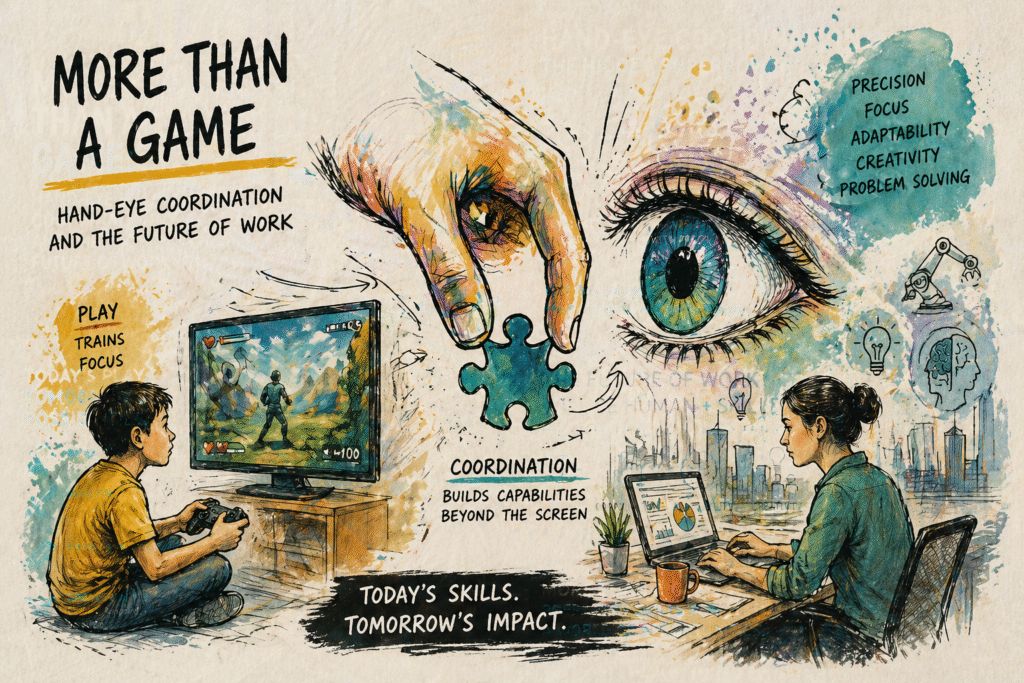
The future of work will not be defined solely by technical knowledge, but by the ability to interact with complex, adaptive systems in real time. It will require precision, adaptability, and fluency with digital interfaces that previous generations did not need to develop. In this context, the young person immersed in a video game today may well be acquiring the foundational skills for tomorrow’s most demanding professions.
What was once dismissed as idle play is beginning to look more like preparation. The controller may not replace the textbook, but it may sit beside it more comfortably than many had imagined. Beneath its seemingly simple presentation—jumping as a plumber, battling dragons, or navigating abstract challenges—something far more consequential is taking place: hand–eye coordination is being refined in real time, as the brain continuously processes visual information and translates it into precise, responsive movement.
And in a future shaped by immersive technologies and intelligent systems, that child in front of the screen may not be escaping the real world at all. He may be learning how to master it.
Douglas Levermore, MBA, JP, is an independent management consultant and the founding Executive Director of Jamaica’s Public Investment Management Secretariat (PIMSEC)—the government unit established to strengthen project appraisal, fiscal discipline, and oversight of public investment, now known as the Public Investment Appraisal Branch (PIAB) within the Ministry of Finance and the Public Service. He also serves as a FINRA arbitrator and a commissioned Notary Public in the Commonwealth of Virginia. Douglas writes on social issues, leadership, management lessons, and organisational strategy, drawing on extensive real-world experience across both the public and private sectors.






Comments