
Dr Marvadeen Singh-Wilmot | Jamaican chemistry, global impact—lessons from the Nobel Prize

/ Our Today
administrator
On Wednesday, October 5, 2025, the Royal Swedish Academy of Sciences announced the 2025 Nobel Prize in Chemistry award to Omar Yaghi, Susumu Kitagawa and Richard Robson for their pioneering work on a class of materials called metal–organic frameworks or MOFs.
At first sight, the name seems intimidating, but the idea is simple: imagine a Lego set with two kinds of pieces. The metal atoms or clusters are like the corner hubs, and the organic (carbon-containing) molecules are like the rods that snap the hubs together. When repeated many times, a rigid 3D framework forms, which resembles honeycombs with countless pores that sometimes link up into channels.
This view is only seen at the atomic scale using special techniques, for example, with X-rays. However, to the naked eye, MOFs just look like salt or sugar. The system of pores and channels in their frame-like structure is what makes MOFs revolutionary for applications such as trapping carbon dioxide, storing hydrogen/oxygen/nitrogen/methane, transporting drugs and diagnostic chemicals throughout the body, or even pulling water from the air. In fact, if the internal walls of just one gram of a MOF are unfolded, the space could cover the area of one football field!
The awarding of this year’s Nobel Prize underscores the global relevance of MOFs, and Jamaica’s scientists have reason to feel the ripple effects of this recognition.
From Kingston to the World
For many Jamaicans, including scientists and students of science, Nobel Prizes feel distant. Yet this year’s award has a direct link to our own laboratories.
At the University of the West Indies (UWI-Mona), the Department of Chemistry has been exploring MOFs and related coordination polymers for over two decades. Their creations, nicknamed UWIMOFs, are registered in the Cambridge Structural Database, the same global archive scientists all over the world rely on to design new crystalline materials. This means Jamaica is not only learning from Nobel science, but we are contributing to it!
Our scientists have built luminescent MOFs that extinguish their glow in the presence of pollutants, detect dangerous metals in water, and respond to explosives. They have helped the world understand the many factors that must be controlled to engineer MOF synthesis, how metals called rare-earths and subtle intermolecular forces can expand the MOF toolkit, and they have built extensive libraries of new MOFs. When a researcher anywhere in the world searches for rare-earth MOF data, they may very well be working with a Jamaican contribution! This, perhaps, is the deeper lesson of this year’s Nobel Prize: science best serves its mission when it is inclusive and enriched by the talents and discoveries that come from people in every corner of the globe. Few stories capture this better than that of Omar Yaghi himself.
UWIMOF-9
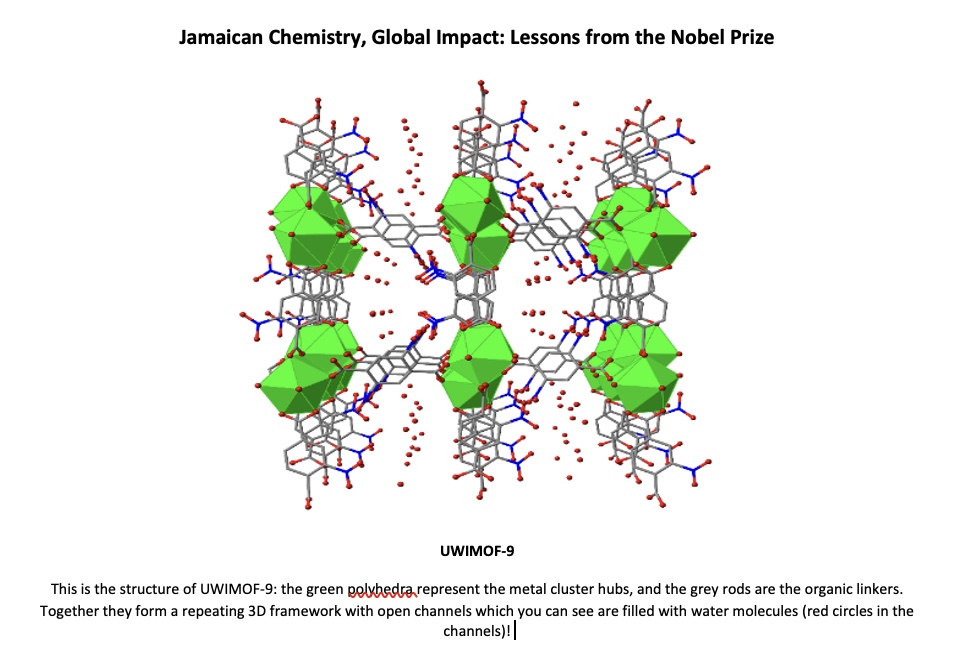
This is the structure of UWIMOF-9: the green polyhedra represent the metal cluster hubs, and the grey rods are the organic linkers. Together they form a repeating 3D framework with open channels, which you can see are filled with water molecules (red circles in the channels)!
Breaking Barriers, Building Frameworks: The Omar Yaghi Story
Yaghi was born in Amman, Jordan, to Palestinian refugee parents. His family lived in a small single-room dwelling that also housed the cattle they raised, with no electricity or running water. His father had only completed the sixth grade, and his mother could not read or write. Yet as a child, Yaghi was captivated by simple ball-and-stick diagrams of molecules he found in a library book.
At age 15, with limited English, Yaghi moved to the United States, supporting himself by bagging groceries and mopping floors while studying at community college and university. Over time, persistence and curiosity propelled him to the highest levels of science, culminating in his Nobel Prize for contributions as the “Father of MOFs”. For Jamaican children who may feel constrained by circumstance, Yaghi’s story is a reminder that brilliance is not born of privilege, but of hard work, persistence, passion, and opportunity.
Why This Matters to Us All
Yaghi’s journey, together with Jamaica’s own MOF discoveries, shows the power of chemistry and equity. Built on fundamental knowledge of how atoms bond, molecules assemble, and matter transforms, chemistry is the foundational science of materials, the language that underlies how we purify water, create medicines, design new technologies, and tackle climate challenges. This is the fundamental knowledge used to design and build MOFs, and when this knowledge is matched with opportunity, whether in a refugee household or a small island laboratory, it becomes a tool of empowerment. Researchers and students in the Chemistry Department at UWI prove this daily, advancing new materials and training the next generation, often with very limited resources. Yet despite the constraints, Jamaica already stands with the world’s best, and our MOFs are in global databases, our discoveries are cited internationally, and our researchers contribute to cutting-edge science. What we need now is sustained investment to move us from keeping pace to leading in areas where our local strengths, like rare-earth MOF chemistry, give us a unique edge.
Dr. Marvadeen Singh-Wilmot is a Senior Lecturer, Head of the MSW Materials Research Group and the Caribbean Regional X-ray Science toward Advancement Laboratory (crXstal), Chemistry Department, UWI-Mona




Comments