
Guyana now world’s 3rd largest per-capita oil producer
Paul Henry / Our Today
administratorSuriname a fast-rising star in the global oil and gas market
Durrant Pate/ Contributor
Guyana is now ranked as the third largest per capita oil producer globally and it comes a mere five years after the first barrel of light crude was lifted from its seabed.
In addition, the South American/Caribbean territory is on course to double its current daily average of about 650,000 barrels in about five years, officials declared. Commercial quantities of oil and gas, first discovered back in 2015, allowing the Caribbean Community’s (CARICOM’s) largest and most resource-rich member nation to begin switching from economic dependence on raw gold, bauxite, cane sugar and timber production among other products to oil and gas today.
American oil giant ExxonMobil made these disclosures in a celebratory news release issued earlier this week celebrating five years since actual production started in December 2019. The company is emphasizing that Guyana’s sweet, light crude oil being produced from three oilfields near the Surinamese border, its current fiscal and other arrangements and relatively cheap operating costs have made the country the ideal production destination.
Oil and gas driving transformative Guyana’s growth
Highlighting that the oil and gas sector is “driving country’s transformative growth,” ExxonMobil Guyana’s deepwater developments are the most successful in the world. In five years, the company has started up three complex offshore mega-projects on schedule and on budget, while simultaneously advancing plans for five additional projects by the end of the decade.
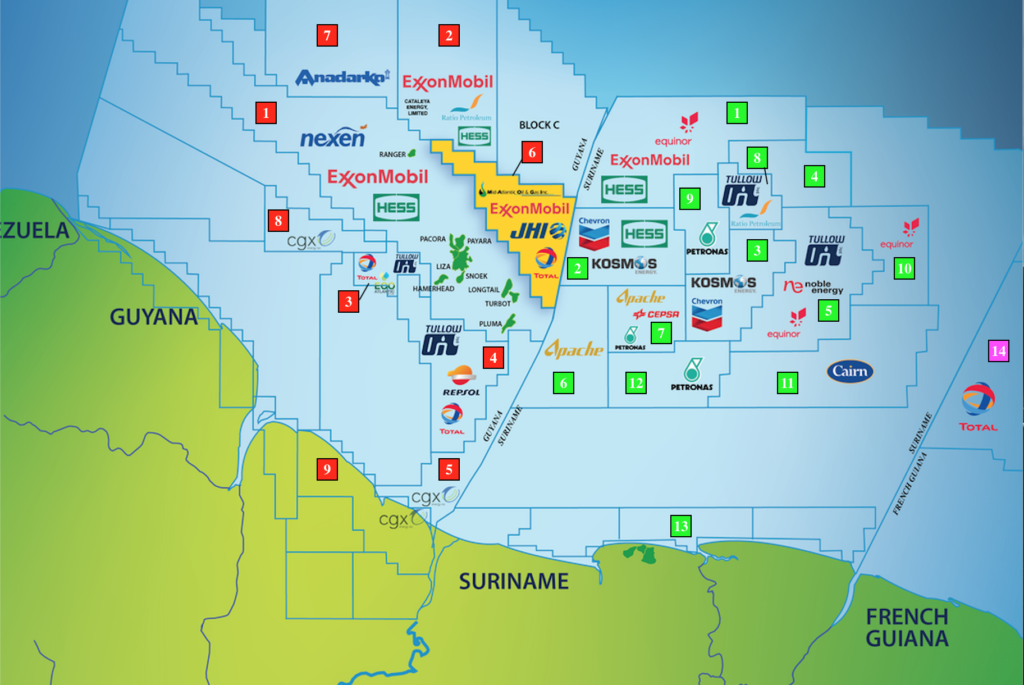
Production capacity in Guyana is expected to surpass 1.7 million barrels per day with gross production growing to 1.3 million barrels per day, by 2030,” the company said in its news release. Exxon is partnering with Hess of the US and CNOOC of China on the offshore venture. Investment to date by the three companies has reached $55 billion according to official figures released recently. Guyana’s success with offshore has sparked significant interest among its fellow CARICOM neighbours to attempt to ramp up interest in their offshore oilfields, not the least among them being Barbados, Grenada and Jamaica.
Neighboring Suriname recently celebrated a final investment decision by Total Energies of France and the American-based, APA Corporation to develop a huge oilfield neighbouring Exxon’s prolific Stabroek bloc where more than 40 wells have been drilled since 2015.
Just last month, the company celebrated half a billion barrels of oil produced offshore Guyana, noting that “our unrivalled success in developing Guyana’s oil resources at an industry-leading pace, cost and environmental performance is built on close collaboration with the government of Guyana, as well as our co-venturers, suppliers and contractors. We remain committed to Guyana for the long term and look forward to continuing delivering for the country.”
Suriname sizzling in oil and gas
Production in Suriname is expected to begin in 2028 and economic transformation in a country with just over 600,000 people is expected to mirror that of Guyana in the coming years. Like Guyana, general elections are due there next year and whichever party wins will have hundreds of millions of oil revenue to dominate opposition parties and spur development.
ExxonMobil Guyana President Alistair Routledge commented, “We’re focused on capacity building, local content development, and environmental stewardship to ensure the benefits of Guyana’s oil-and-gas production reach every corner of the country. We’re grateful for the strong collaboration with our co-venturers, Hess and CNOOC, and with the government of Guyana—all of whom have played crucial roles in responsibly developing Guyana’s natural resources.”
Ironically, Exxon has pulled out of exploration plans in Suriname and other places around the world to concentrate on Guyana because of its cheap operating costs-averaging less than US$35 per barrel—and tax-free and other concessions that have made its arrangements with Guyana a very profitable venture. Opposition parties and environmental groups have been lobbying for better revenue-sharing terms for the country.



Comments