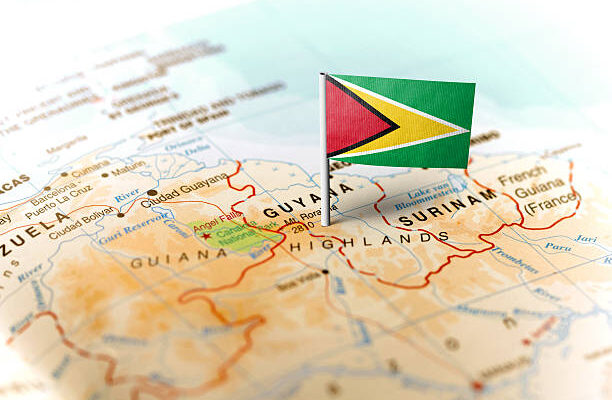
Guyana’s economy records 7.5% growth in the first half of 2025

/ Our Today
administrator
Durrant Pate/ Senior Business Journalist
Guyana’s economy continues on a trajectory of strong, broad-based economic growth of 7.5% for the first half of 2025, underpinned by continued expansion in the oil and gas sector.
This is in addition to a robust performance across the non-oil economy, which expanded by 13.8%, representing the fifth successive year of expansion, following the contraction in 2020. Based on the developments in the first half of the year, real GDP growth projected for 2025 has been revised upward to 15.2 per cent from 10.6 per cent, and 13.9 per cent for non-oil real GDP, up from 13.8 per cent.
The 2025 Mid-Year Report, which was recently released, highlights the key sectoral performance of the Guyanese economy as follows:
Agriculture, Fishing, and Forestry
The agriculture, fishing, and forestry sector expanded by an estimated 9 per cent in the first half of the year:
- The sugar industry expanded by 136.7 per cent when compared with the first half of 2024, with the full-year growth projection maintained at 115.4 per cent.
- The rice industry grew by an estimated 13.9 per cent in the first half of the year and is now expected to grow by 12.4 per cent for the entire year.
- The other crops subsector is estimated to have grown by 7.4 per cent in the first half, with a revised growth projection of 11.9 per cent for the entire year.
- The livestock industry expanded by an estimated 11.7 per cent in the first half of the year, driven by increased output across all products. The subsector is now expected to grow by 7.2 per cent for the entire year.
- The forestry industry is estimated to have grown by 6.2 per cent in the first half, and growth is expected to remain unchanged at 1.3 per cent for the year.
Extractive Industries
The mining and quarrying sector is estimated to have grown by 5.9 per cent in the first half of the year, driven by increased output across all subsectors – bauxite, gold, other mining and oil and gas.
- The petroleum subsector grew by an estimated 5.5 per cent, with 115.7 million barrels of oil produced in the first six months of this year. The industry is now projected to grow by 15.6 per cent for the entire year.
- The bauxite industry is estimated to have grown by 133.1 per cent in the first half of the year, and the sector is now projected to grow by 65.9 per cent for 2025.
- The gold industry grew by an estimated 10.9 per cent in the first half of 2025, with higher declarations from the single large producer and the small- and medium-scale miners. The sector’s growth target for 2025 remains unchanged at 17.2 per cent.
- The other mining and quarrying industry – which comprises sand, stone, diamonds and manganese – is estimated to have grown by 24.2 per cent in the first half, driven by greater activity in the construction sector. This industry is now expected to grow by 21.2 per cent in 2025.
Manufacturing, Services and Construction
- The manufacturing sector is estimated to have grown by 26.8 per cent in the first half, driven by growth across all subcategories – other manufacturing, rice and sugar. The sector is now projected to grow by 14.9 per cent this year.
- The services sector is estimated to have expanded by 6.6 per cent in the first half of the year, primarily supported by growth in wholesale and retail trade and repairs, administrative and support services, financial and insurance activities, professional, scientific and technical services, and information and communication. The overall 2025 growth target for services is now 8.6 per cent.
- The construction sector is estimated to have grown by 29.9 per cent in the first half of 2025, supported by Government’s expanded Public Sector Investment Programme, along with robust private sector investments across several sectors. The sector is now expected to grow by 26.2 per cent in 2025.
BALANCE OF PAYMENTS
The overall balance of payments recorded a surplus of US$10.3 million at the end of the first half of 2025, with the current account recording a surplus of US$197.9 million. The merchandise trade balance registered a surplus of US$3,180.2 million. This mainly reflects the fact that, while crude exports grew by 2.6 per cent, less favourable oil prices prevailed.
Non-oil export earnings, however, increased by 12.5 per cent to US$919.7 million, mainly supported by gold and bauxite,e expanding by US$147.5 million and US$31.1 million, respectively. Total import payments stood at US$5,894.6 million at the end of the first half of the year, growing by 81.1 per cent.
Growth was mainly attributed to the expansion in the imports of capital goods, which rose to US$3,881.7 million and accounted for 95.8 per cent of the overall increase. A significant portion of this increase can be attributed to the importation of the One Guyana FPSO, which is valued US$2,534.1 million.
MONETARY DEVELOPMENTS
Domestic Credit
At the end of the first half of 2025, net domestic credit stood at $1,015.5 billion, exceeding the December 2024 position by 17.7 per cent. Total credit to the private sector grew by 7.7 per cent to $485.4 billion at the end of the first half of the year.
- Credit to households rose by 7.3 per cent to $51.8 billion, with notable growth of 20.3 per cent observed in lending for motor cars.
- With respect to credit to business enterprises, there was notable growth in lending for services, manufacturing, and agriculture, of 4.9 per cent, 12.4 per cent, and 1.1 per cent to $165.6 billion, $48.7 billion, and $31.9 billion, respectively.
Real estate mortgages expanded by 11.4 per cent to $173.5 billion, driven by increases in mortgages granted for private dwellings and industrial and commercial properties.
The Mid-Year Report underscores Government’s wide-ranging measures to boost disposable incomes and cushion households from the impact of rising cost of living, including:
- Introducing no new taxes in Budget 2020 to 2025.
- Doubling the income-tax threshold to $130,000 per month.
- Reducing income tax rates.
- Introducing tax relief for persons with children, persons who earn overtime for work beyond their normal working hours, persons who have a second job, and persons who are paying premiums for life and medical insurance.
- Distributing a $100,000 cash grant to every adult citizen.
- Doubling old age pension (OAP) from $20,500 per month in 2020 to $41,000 now.
- More than doubling Public Assistance grants from $9,000 per month in 2020 to $22,000 now.
- Maintaining the zero per cent excise tax on petroleum products to mitigate the impact of rising fuel prices globally, saving consumers $560 per gallon currently.
- Extending freight charge reductions.
- Continuing the part-time job programme.
The Report highlights that across every single sector of government activity, there has been substantial progress and development. In education, Government has advanced universal access to education, as well as expanded technical and vocational training. In health, Government completed regional hospitals, expanded diagnostic services, and continued the digitalisation of patient care systems. Further, social protection programmes, such as cash grants, school uniform grants, and increases in pension and public assistance, have directly increased disposable incomes at the individual and household level, particularly for the most vulnerable.
Inflation
Consumer prices rose by 2.9 per cent when compared with the end-2024 position. While energy prices – prices at the pump for gasoline, diesel, and kerosene – declined in the first half of the year, accounting for -0.2 of a percentage point, food prices increased. The prices for gasoline, diesel, and kerosene were reduced by 20.9 per cent, 32.8 per cent, and 34 per cent, respectively, when compared with the position at the end of 2024, bringing significant relief to Guyanese producers and consumers. The 12-month inflation rate stood at 4.2 per cent at the end of June and is now projected to be 3.1 per cent for 2025.



Comments