Influx of seaweed threatens Caribbean economies and wildlife

Nathan Roper / Our Today
author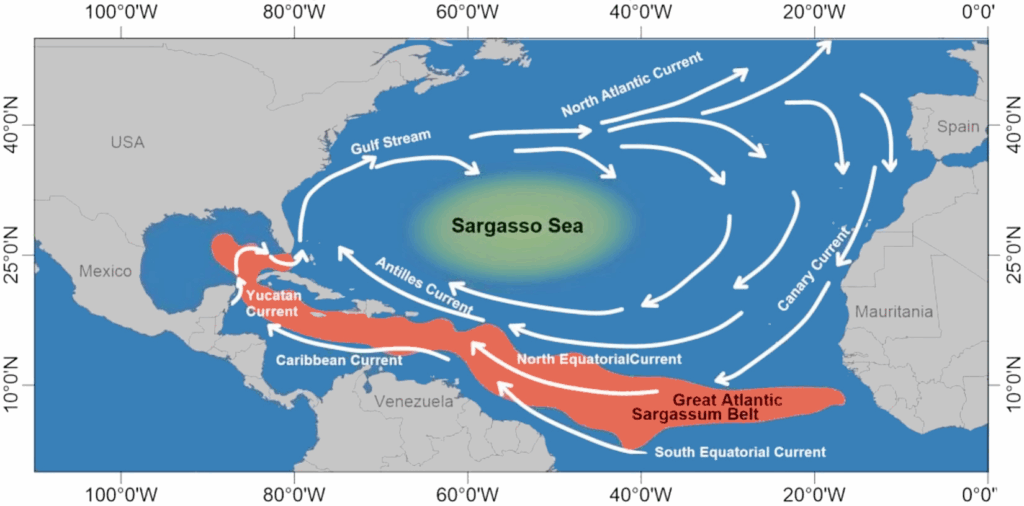
The Caribbean region has experienced a record increase in the amount of seaweed washed up along shorelines over May, with this trend set to continue into June and beyond. These aquatic substances, which are estimated to weigh roughly 38 million metric tons, have caused significant economic and ecological disruptions.
A report released on Monday, June 2, by the Optical Oceanography Lab of the University of South Florida identifies a steady but significant growth in the quantity of seaweed entering the region, travelling along the Great Atlantic Sargassum Belt into the Caribbean and Gulf of Mexico. On average, the amount of displaced seaweed grows every year, with the previous record having been set in June 2022, with 22 million metric tons of algae identified.

Brian Barnes, Assistant Professor at the University of South Florida who helped write the official report on the seaweed, states that the “peaks continue to get bigger and bigger every year”, with members of the Optical Oceanography Lab having studied the phenomenon in the Great Atlantic Sargassum Belt since 2011.
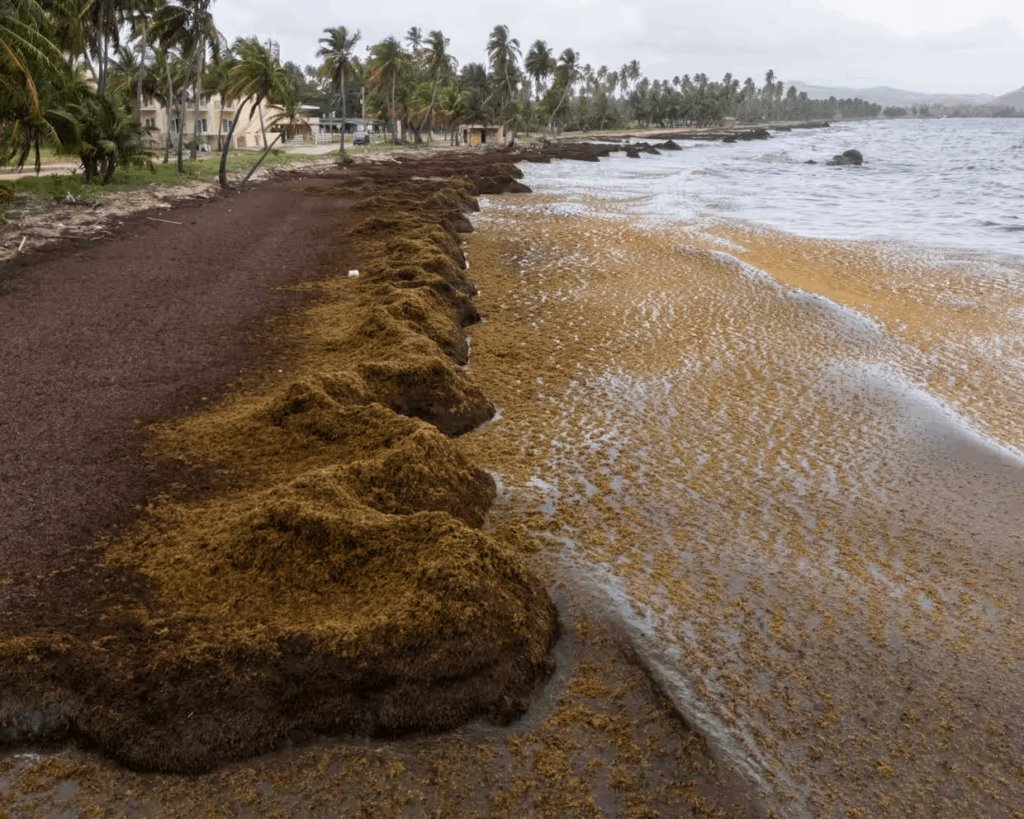
The seaweed is reported to have caused significant adverse effects across the West Indies, affecting territories and nations from Guyana to Puerto Rico. The Eastern Caribbean Islands of the Lesser Antilles are said to be at the most risk, with the algae encasing significant swathes of their coastline. This has killed much wildlife, prevented use of beaches for tourists and locals, left behind a powerful and undesired odour, and even released toxic gases, which have put people at risk.
“[Why this is happening] is the million-dollar question,” Barnes said. “[But] I don’t have a supremely satisfying answer.”
The assistant professor clarified that three distinct types of Seaweed were present in the Caribbean, being dependent on a variety of factors, including nutrients, sunlight, and a satisfactory water temperature to both survive and reproduce. Barnes went on to say that it is theorised that the changing climate, including warmer Sea Levels and slight diversions to the standard Oceanic currents, may be behind the sudden increase of Algae levels in the region.
He clarified that Seaweed is not necessarily a bad thing for the environment, being a vital part of the local ecosystems, providing food for aquatic life. However, the ideal circumstances for algae involve it being out in the open ocean, not bashing against various coastlines. In these scenarios, it can be an existential threat to both shipping and the marine fauna that inhabit the area.






Comments