
Jamaica’s current account balance set to worsen over the near term

/ Our Today
administrator
Durrant Pate/Contributor
Latest projections from the Bank of Jamaica (BOJ) suggest Jamaica’s current account balance is expected to deteriorate over the near term.
This is largely underpinned by the negative impact of Hurricane Melissa on Tuesday, October 28, 2025, on the tourism industry, as well as the increased import needs for infrastructure rebuilding and relief supplies. The current account balance is a key economic indicator tracking a country’s net income from international trade in goods, services, earnings on investments, and transfers.
The deterioration in the current account, however, will be slowed by increased remittance inflows and insurance receipts. In this context, the BOJ anticipates that the current account balance will fall within a range of a deficit 0.5 per cent of GDP to a surplus of 0.5 per cent for FY2025/26, compared with a surplus of 3.0 per cent of GDP recorded in FY2024/25.
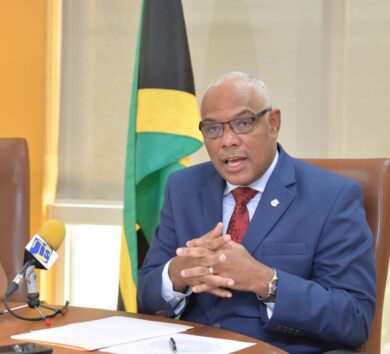
However, BOJ Governor Richard Byles was quick to emphasise, “notwithstanding the worsened BOP current account, Jamaica’s international reserves remain robust, standing at a historically high level of US$6.8 billion as at February 19, 2026, representing about 155.8 per cent of the measure considered adequate.”
Above adequate capital adequacy ratios
Addressing the bank’s quarterly news briefing, Governor Byles was quick to trumpet that the domestic financial system has been resilient in the aftermath of Hurricane Melissa and that incoming macro-economic data indicate that the initial direct effects of the storm on inflation have been less severe than earlier projected.
Referencing deposit-taking institutions (DTIs), Byles reported that they maintained capital adequacy ratios above the regulatory benchmark. This, he explained, reflected broad resilience in possible scenarios of market, credit and liquidity risk shocks.
According to the BOJ Governor, “while there has been a mild deterioration in DTIs’ asset quality, with the ratio of total non-performing loans (NPLs) to total loans increasing to 2.8 per cent at the end of 2025, coming from 2.5 per cent at the end of 2024”. In addition, the ratio remains more than comfortably within the prudential benchmark of 10 per cent.
He pointed to private sector credit, declaring that it has remained fairly stable, recording annual growth of 8.0 per cent at December 2025 compared to growth of 7.3 per cent a year earlier.
FX market operations
Since the passage of the hurricane, the BOJ has sold approximately US$365 million into the market over the period 01 November 2025 to January 31, 2026. The bank also sold US$87 million to Petrojam over this period, resulting in cumulative sales of US$452 million.
Importantly, the BOJ has purchased approximately US$152 million since the hurricane. Governor Byles told the quarterly briefing, “The Bank has therefore delivered on that promise of foreign currency price stability. The exchange rate has appreciated since November 2025, supported by strong foreign currency inflows, reflecting improved remittances, as well as the Bank’s use of its healthy reserves to augment flows in the market and the other special measures that we announced since November.”
Cumulatively, the BOJ sold US$1.1 billion via its BFXITT facility over the 12 months to January 2026, in line with the US$1.1 billion sold over the 12 months to end January 2025. Notwithstanding these sales, the BOJ’s net purchased US$990.5 million over the 12 months to end-January 2026.
Going forward, Jamaica’s international reserves should remain healthy and are projected to improve even further.




Comments