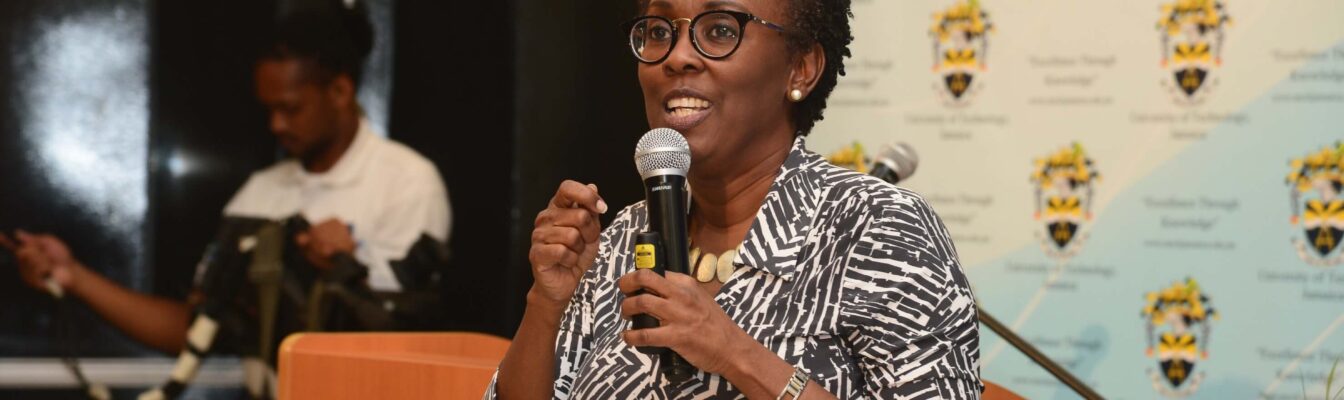
Jeanette Calder | Real-time Melissa audits must lead to real-time accountability

/ Our Today
administrator
To date, there are many people whose lives remain shattered by the passage of Hurricane Melissa.
All the more reason to be vigilant to ensure good practices in procurement and distribution for relief and recovery prevail.
Against this background, the Jamaica Accountability Meter Portal (JAMP) is gravely concerned by the breaches of the procurement law as identified in the Auditor General Department’s “Real-Time Audit of the Hurricane Melissa Relief Initiative” (February 2026).
The subsequent public response by the Minister of Energy and Telecommunications, Daryl Vaz, that the Auditor General’s findings with respect to purchase and distribution of starlink devices are “uninformed and grossly inaccurate” and that “all actions taken were in keeping with the “Guidance note on the acquisition of goods, services and works in the situation of emergency or extreme urgency”, is unsupported by the law and details given in the AG’s report.
The legal framework is clear. The Public Procurement Act, and the subsequent amendments, unambiguously state that “in a situation of emergency or extreme urgency, the head of a procuring entity should organise the procurement processes of the entity so as to enable a swift and decisive response” and the decisions “must be approved by the head of a procuring entity” and must be in place “before invoking the emergency or extreme urgency provisions of the act”.
Neither the act nor the guidance note, which Minister Vaz referenced, contains provisions permitting ministerial initiation of procurement, selection of suppliers, or direction for delivery of assets.

To compound the error, rather than deliver the 200 devices to the purchaser (ODPEM) to be inspected and documented as the 2020 Comprehensive Asset Management Policy requires, on Ministerial instruction, they were delivered to the Office of the Police Commissioner, bypassing ODPEM’s chain of custody controls designed by the GOJ to protect our assets.
Minister Vaz indicated that he made these decisions in order to “have them distributed to the relevant state agencies and recovery teams in the quickest possible manner”. However, ofthe 200 devices handed over, the Auditor General was unable to certify if any were in use up to January 6. 80 remained with the JCF in storage, 13 were over-allocated and returned to the JCF’s storage, 41 were disbursed but not used, and 66 were assigned to various entities but with no confirmation of usage.
The Auditor General’s report indicates that some Starlink kits came without installation peripherals, and all were fitted with a European plug that is unsuitable for Jamaica’s electrical standards, resulting in unplanned additional costs. This represents a loss in value for money.
Is bureaucracy the issue?
No, it is not. The decision to award the contract for $12.12 million rested with the head of ODPEM without any requirements that would lead to time-consuming external scrutiny and permission.
Our laws provide mechanisms for emergency procurement precisely to ensure that responsiveness and legality co-exist. The Holness administration and the Parliament did good work in strengthening both the asset management procedures in 2020 and the emergency procurement processes in 2025. Their objective was to reduce bureaucracy and fear in procurement decision-making, as well as increase accountability.
What JAMP calls for:
For real-time audits to have value, there must be real-time accountability. JAMP therefore calls for:
1. Cabinet responsibility: Cabinet is obligated to uphold the rule of law. It has a duty to address breaches of statutory requirements by its members and to hold them accountable. Minister Vaz’s refusal to acknowledge his procurement and policy breaches and accept responsibility for the resulting delays, inadequate deployment and usage of the devices and additional costs to make the devices usable warrants Cabinet’s attention and response.
2. Further enquiry by the Public Accounts Committee, as the primary parliamentary body responsible for reviewing audit reports, the PAC should seek further clarity on these findings, and what measures will prevent recurrence of all breaches, including the total disregard for proper asset management by several entities and the Auditor General’s inability to obtain responses.
3. Accountability by the director general of ODPEM – The director general of ODPEM must account for his role in the process. The Public Service Commission, in consultation with the financial secretary, should determine whether the director general:
- was subjected to improper ministerial pressure
- lacked understanding of his obligations under Section 20 of the Public Procurement Act
- should face a surcharge or any other sanctions for failing to uphold statutory responsibilities.
If accounting officers facilitate or acquiesce to practices that breach laws and policies without consequence, the anti-corruption and public accountability framework is severely threatened.
4. Protections for Accounting Officers: The Ministry of Finance should re/issue clear guidance on: –
- What is expected of accounting officers who receive unlawful ministerial directives
- What legal protections exist for officials who uphold their obligations when confronted with political interference.
The importance of this case extends beyond a single procurement transaction. Much is made of good intentions as justification for any and all actions. However, when such actions breach existing law and policies and cannot pass tests of transparent, accountable stewardship and value for money, good outcomes are compromised. Impunity for the actors gives permission for others to follow suit, a cycle of poor governance results and the circumstances of those most in need remain.
Jeanette Calder is the executive director of the Jamaica Accountability Meter Portal (JAMP). Send feedback and comments to [email protected].






Comments