Lee-Chin urges ‘Marshall Plan’ for Jamaica to build resilience after Hurricane Melissa

Toriann Ellis / Our Today
author
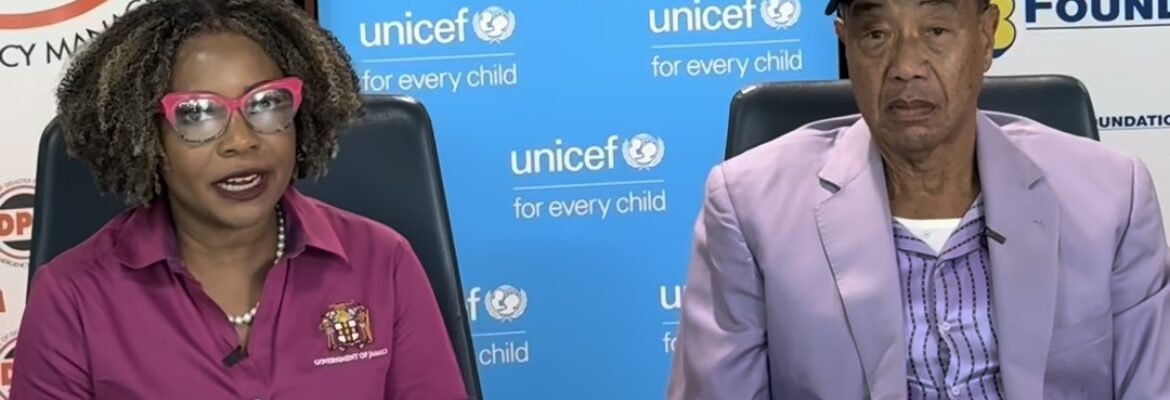
Chair of the National Commercial Bank (NCB) Financial Group Limited, Michael Lee Chin, outlined that the occurrence of natural disasters will be a recurring phenomenon, but called on stakeholders to build resilience by adopting the Marshall plan used by other nations, so that affected citizens can get back to a place of self-actualisation.
“I have no food. I have no water. I have no shelter. That’s a cry coming from too many individuals in the West. It’s a cry that should have been or could have been from all of us in the rest of the island. We don’t know what will happen tomorrow. We had Beryl in 2024, now Melissa in 2025. So today we have to respond to the cries of our brothers and sisters and at the same time build resiliency for the future,” Chin said.
Speaking at the signing of a Memorandum of Understanding (MOU) between Food for the Poor Jamaica, American Friends of Jamaica (AFJ), UNICEF Jamaica, Global Empowerment Mission (GEM) and N.C.B. Foundation regarding the administration of funds to support post-hurricane Melissa relief efforts across Jamaica, Chin said it takes two dots to make a line graph, meaning it takes two natural disaster to set back civilisation.
“We have had two dots. We had Beryl in 2024, and now we have Melissa in 2025. What does that say about 2026, 2027 and the future? What we can conclude is that these occurrences are going to be more vicious and more frequent,” he added.

Referencing Maslow’s Hierarchy of Needs, he highlighted that this theory should serve as a framework for addressing the needs of all affected brothers and sisters to restore them to be better than before.
“Well, in 12 hours, a lot of our brothers and sisters went from the apex of that pyramid right down to the base. Whereby they had self-actualisation. They’re independent individuals, and now they have no food, water or shelter. It could have happened to any one of us. It could have happened to all of us in Kingston.
“Our job really is to use this hierarchy, this pyramid, as a guide, as a framework. Because it speaks as to what we have to do. Initially, we have to supply food, water, and shelter to our needy brothers and sisters. We have to provide them with safety, social, family, esteem, and ultimately, self-actualisation. We have to restore to where we were before,” he continued.
He emphasised that, as stakeholders, in building back Jamaica, they don’t have all the answers to building resilience. “This is new to all of us. There’s no precedent for a Category 5 hurricane in Jamaica. But a path to resiliency can be guided by a famous quotation [If I had an hour to solve a problem, and my life depended on the solution, I would spend the first 55 minutes determining the proper questions to ask. For once, I know the proper questions, I could solve the problem in less than five minutes, Albert Einstein],” Chin said.

He noted that Jamaica should spend the time to ask the right questions in an effort to develop a Marshall Plan reflecting the state’s current situation. “What can we do to ensure Jamaica’s resiliency outside of praying? These are existential threats. In terms of Melissa, how do we ensure that the devastated areas don’t devolve into Gaza-like, irreversible, vicious circles? There is a precedent of totally obliterated people, cities, and towns. It’s a precedent that we can draw from Europe after World War II. The resiliency plan was the Marshall Plan. That was the resiliency plan, which rebuilt Europe to what we know it is today; $13 billion was spent after the war.”
However, he detailed that the big risk the country faces today is that with time, the unaffected areas will become desensitised to the plight of its brothers and sisters because they have normalcy. “That’s the big risk we have today, and secondly, half-life will set in, and there will be no more urgency with time.
“We therefore have to remain sensitive to the fact that those of us who can, should. I am proud of NCB Foundation and our partners in taking the leap from the different phases that are going to be necessary to ensure that we get to the point of resiliency and making sure, in the short term, our brothers and sisters can get back to being self-actualised,” Chin added.



Comments