
Maverley Primary empowers parents with entrepreneurship training

/ Our Today
administrator
Jamaica National Bank (JN Bank) recently partnered with the Maverley Primary & Infant School to educate parents on entrepreneurism.
The initiative aimed to address the stigma associated with Maverley as a volatile inner-city community, which has had a negative impact on the economic outcomes of many residents.
Although some resort to micro entrepreneurism — setting up shops or stalls on the roadway or near their homes to provide for themselves and their families — without the education, training and know-how to manage a business, most of their operations are often stunted by the labels or fall into inertia, barely making enough to make ends meet.
The circumstances are highlighted at the Maverley Primary & Infant School, where many of the community’s children receive their first formal education.
According to Principal Valentine Spencer, just a fraction of parents are employed full-time and almost all earn a minimum wage.

“Of the 375 students, at least 70 per cent of the homes that the children come from are single-parent households with mother only or father only. I have seen a few father-only homes, and what I find is that they are either unemployed or they do their own thing in order to make money, such as building up a shop to sell things, or manual labour,” he stated.
According to statistics from the Planning Institute of Jamaica, at least 47 per cent of Jamaican children live in single-parent households with their biological mothers.
Vice Principal Kerry Taffe believes that with training, motivation and understanding how to access and manage finance, many of Maverley’s micro entrepreneurs can fare better economically. She noted that while some have basic knowledge and have a desire to start their own businesses, many are afraid or don’t know where to start.
For this very reason she decided, with the support of Spencer and teachers at Maverley Primary, to coordinate a financial literacy and small business forum, calling on the support of JN Bank Small Business Loans and the JN Foundation to bring knowledge to some 50 parents – mostly women – in the community and boost their courage.
“Based on observation, they have skills, but because of living in this community, there is a stigma attached to them when it comes to employment opportunities and many of them are not certified. I have written a lot of recommendations for persons, but the jobs that they are taking up are minimum wage jobs,” Taffe noted.
“Unexpected flare ups of violence in the community also impact the businesses that they open, such as hairdressing and nails.”
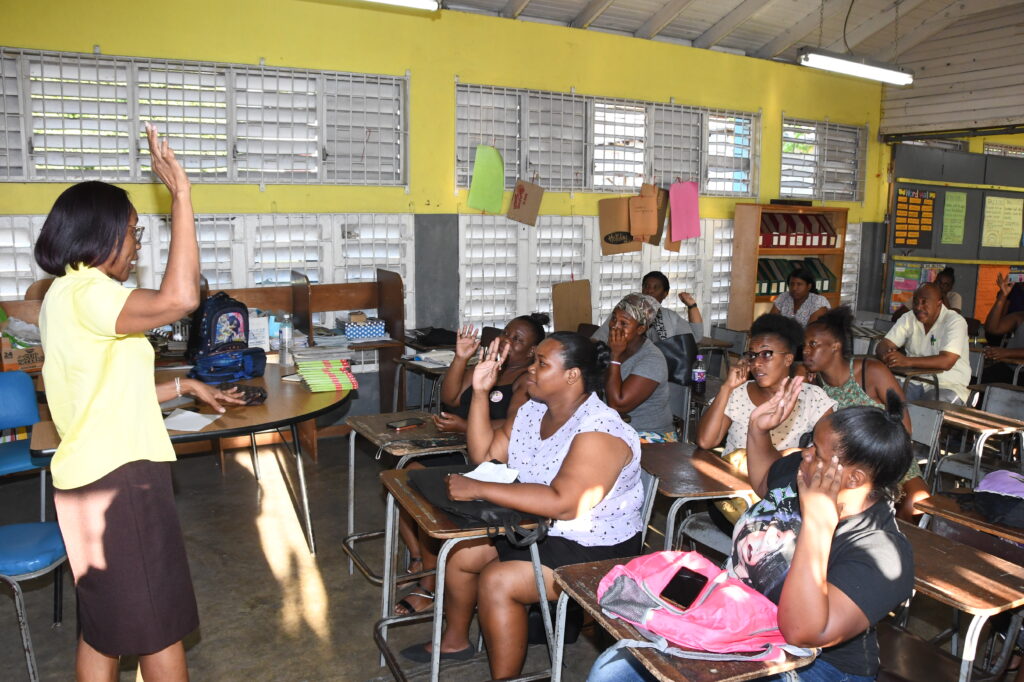
According to a study conducted by The University of the West Indies, some recipients of financing from the company were better off economically than those who had never received a JN loan. As such, during the forum the JN team introduced the attendees to a four-point financial management road map, teaching them about budgeting, saving, investing and credit.
They also taught them how to prepare and apply for financing, as well as manage loans. And they were urged not to delay starting their businesses.
However, starting up a business without collateral can be very difficult. As such, the training stressed the importance of maintaining a good reputation and character that will support their access to loans.
“Character goes a far way in business, especially if you’re seeking financial opportunities to start a business, grow the business or to expand on the business,” she said, although noting that JN Bank accepts appliances as collateral for its micro loans. “When we speak of character, we are talking about integrity, honesty, and respect. Because if you come to us for a loan, we are expecting that once you get it, you’re going to start the business and develop on it in order to repay the loan,” Lindsay said.
She advised the attendees to also make their loan payments on time, as late payments and delinquency could affect their character in the eyes of financial institutions or anyone willing to finance their business.
Lindsay noted that when someone borrows, their payment history is collected by entities known as credit bureaus that then provides the information to all financial institutions, so that they will have an idea of the borrower’s character should they apply for a loan or other forms of credit.
“Everywhere you go to borrow, you leave a ‘footprint’ so every financial institution where you borrow and don’t pay it off, everyone will know, and if you pay it off, it’s great for you because then, you’ll always have the opportunity to borrow again. But once you’ve messed up that opportunity, it makes it harder for you to provide for yourself and your family,” she explained.
Sharon Smith, who attended the forum and operates her own retail micro business, buying and selling trinkets and other items seasonally, said she was grateful for the information presented.
“It was very informative. I learned about doing market research to find out what’s in demand and what persons can capitalise on. Learning about budgeting and saving was also useful,” she said.
Principal Spencer said the school will be organising more sessions to provide parents with information to increase the knowledge, awareness and confidence of parents and ensure they are well-positioned to look after their families.
“We want parents in the community to be better able to provide for themselves and their children as some of the students are coming to school without a proper meal or money to purchase food; or they don’t come to school at all because parents cannot afford the lunch money, which is no more than $350,” he said.

“What I’ve found is that we have to be feeding the children. We have to be giving them lunches or snacks. And these are not students who are on the PATH programme, these are persons who have not been successful at signing up for the programme. And it’s not that the parents are not willing to try. They are willing to try, but some of them are just unable because of the age of the children or illness,” he pointed out.
He said the school has implemented a welfare programme to assist students with lunch and breakfast, free of charge, from Wednesdays to Fridays. But, by empowering parents to support themselves and their families, a more sustainable approach can be developed that will benefit the students, the school, and the community.
Rose Miller, financial empowerment coach at JN Foundation, says financial independence is very important and JN will be returning to the school to continue the education and training.
“As we seek to empower our members and the community at large, we are very focused on impact, and it was great to see the enthusiasm of the parents and teachers,” she said. “We are committed to helping them to delve into business because they understand that it’s one of the routes they can use to gain financial independence. And because many of them are chief breadwinners, they have to do things that will increase their income and ultimately pave the way for financial security,” she said.





Comments