
Renewed Wigton Energy focused on growth, diversification
Josimar Scott / Our Today
author
After recovering from Hurricane Beryl’s heavy blow to it operations and rebranding itself to reflect an expanded focus on renewable energy, Wigton Energy has improved both its half-year revenue and profitability.
The company reported a 33 per cent increase in revenues, which amounted to $1.33 billion, due to increased wind production over the six months ending September 2025. This growth reflected Wigton’s rebound from the impacts of the passage of Hurricane Beryl on July 3, 2024, which resulted in lower output for the third quarter of that year.
Gross profit of $863.17 million eclipsed the $572.14 million earned in half-year 2024, while other income fell to $210.12 million due to a one-off payment of insurance related to Hurricane Beryl.
Net profit for the period came in at $354.47 million or 14 per cent higher than the corresponding period in 2024. However, third quarter net profit of $95.30 million was 33.8 per cent lower than the same period last year.
Future-proofing Wigton earnings
CEO of Wigton Energy Gary Barrow shared during a Mayberry Investor Briefing on Monday that since the passage of the hurricane last year, the company has strengthened its infrastructure to withstand similar climate incidents. He was providing an update on the impact of Hurricane Melissa, which made landfall in Jamaica on October 28, 2025.
“We fared pretty well from all visible damage as well as inspections that we have done to date,” he told Mayberry Investments Limited’s Assistant Vice-President (AVP), Investment Banking, Rachel Kirlew.
“We are seeing just really limited damage associated with Phase 1. Phase 2, Wigton 2, and Phase 3, Wigton 3, we are seeing very little to no damage… And part of that had to do with some reinforcements that we did based on our lessons from Beryl,” he continued.
When Mayberry Investments AVP Relationship Management Melesia Jones asked how the company plans to remain resilient in the face of extreme climate activity, Barrow reiterated that the company has invested in its productive assets.
“We were able to do certain engineering modifications that made the turbines more robust, and when we are making these investments, though, we consider the strength and the hurricane rating for the facilities that we put in place. So, that is something, of course, we’ll be paying a lot of attention to going forward,” the Wigton Energy CEO outlined.
Moreover, he pointed to the company’s diversified investments into solar energy production as it seeks to fulfil a power purchase agreement to supply the Jamaica Public Service with 49.83 megawatts (MW) of electricity. That project will see Wigton Energy developing a solar farm in Lionel Town, Clarendon, at a cost of about $50 million while increasing its energy production by 50 per cent.
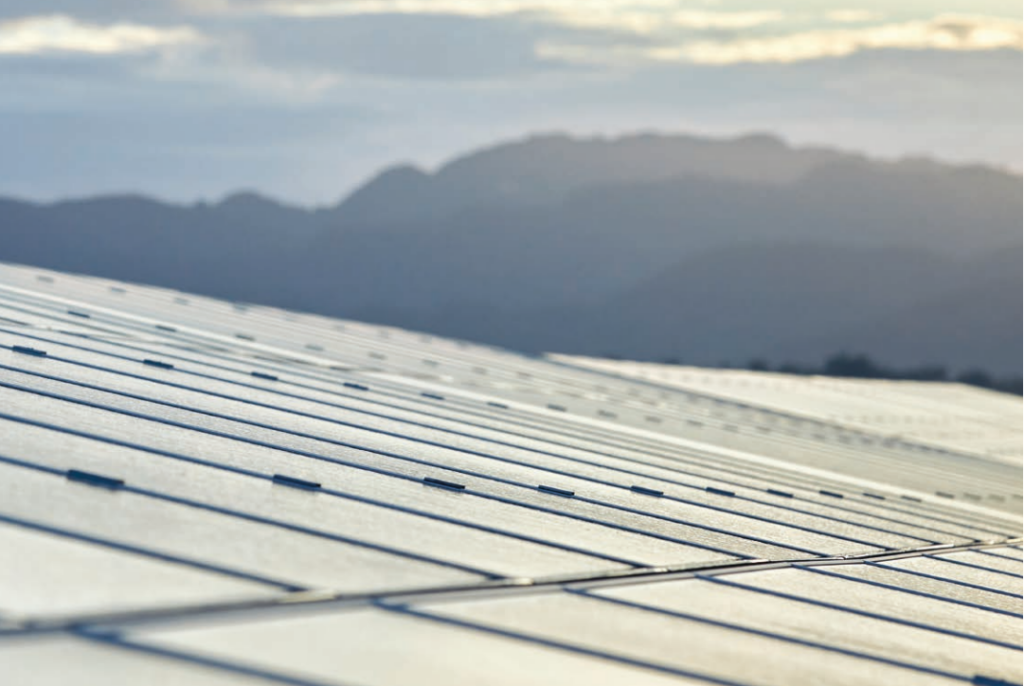
In addition, the company has begun repowering its 20.7 MW Wigton Phase 1 with solar energy.
According to Kirlew, these investments will position Wigton as the largest provider of renewable energy in the English-speaking Caribbean to benefit from increasing demand for the utility.
“We saw, certainly, in our instance, where we have done significant solar investments, where the solar stood up pretty well and, in fact, you know, we have implemented solar that can withstand Category 5 hurricanes. So, just a diversification of the type of renewables that we offer, I think, is important,” Barrow said, still responding to the question on climate resilience.

He added that the development in Lionel is not just for energy diversification but also geographical diversification, as it will enable the energy producer to have redundancy and “mitigate the impact of extreme climate conditions”.
Negotiation and financing
So far, Wigton Energy has completed negotiations with Jamaica Public Service on the PPA to provide 49.86 MW of electricity and is now awaiting approvals from the Office of Utilities Regulations.
“Of course, there’ll be further discussions that are maybe tripartite discussions to bring that to a conclusion. So, we are really very advanced. We’re also advanced with our engineering procurement and construction contract,” Barrow shared.
Wigton has also secured approvals from the National Environmental Planning Agency for the construction of the solar plant. Among other things to be completed, the company is now soliciting debt financing arrangements from various financial institutions.
Responding to a query from Damian Whylie, Mayberry Investments general manager for asset management, on how Wigton plans to finance its solar project, Barrow revealed that it will be a combination of debt and self-financing.
In preparation to take on new debt, the CEO said, Wigton has focused on reducing its debt stock.
“We have two major instruments now that we are repaying our interest on. There’s a bond, one particular bond that has been amortised and we’re paying down on that, and then there’s another bond we’re repaying interest, and at a point in time we’ll make a bullet payment,” Barrow shared.
“But you can see the impact of the, the, the, um, payments, um, on the financials and, uh, on the profitability,” he continued.
Year on year, Wigton’s non-current liabilities have fallen by 22.9 per cent to $2.91 billion
“Of course, as we consider the financing for the 50 megawatt and the 20 megawatt [projects], there’s an expectation that the gearing will again change as we take on additional debt and take on additional equity, but that really is a reason why we’re seeing our liability going down because we’re paying off the current debt aggressively,” Barrow explained.
He added that as Wigton Energy looks to balance its dividend payments with project financing, the company has developed “a very detailed” cash flow projection for the next two years. Furthermore, the CEO noted that when determining dividend payments, factors such as cash availability and profitability are taken into account.
Wigton paid out $102.43 million in dividends in 2024.
“We recognise our primary role is to improve shareholder value, and we know shareholders are looking for dividends, and secondly, they are looking for long-term growth, you know. And long-term growth is reflected, happens through investments and ultimately in the increase in share prices,” Barrow noted.






Comments