
Strategic Resilience: Embedding Sustainability in Post-Crises Recovery

/ Our Today
administrator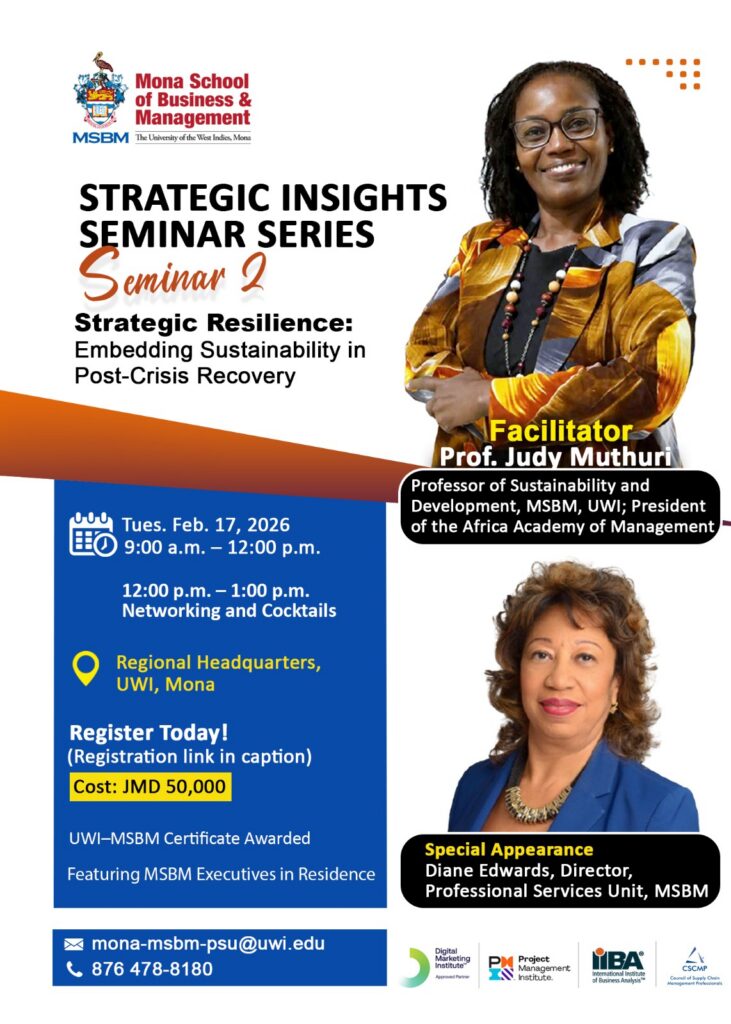
The Mona School of Business& Management will be hosting another edition of its “ Strategic Insights Seminar Series on Tuesday, February 17, entitled “ Strategic Resilience: Embedding Sustainability in Post-Crisis Recovery.”
Diane Edwards, Director of Professional Services Unit at the Mona School of Business & Management, will be speaking on this subject.
· Sustainability is defined as the capacity of an organisation to create and maintain long-term stakeholder value without depleting social, environmental, economic and governance resources it depends on to thrive over time.
· Strategic resilience is not about preparing for the last crisis. Sustainability enables organisations to still operate, compete and grow despite environmental, economic, social or political disruptions. It is about designing the organisation to remain viable through future shocks.
· Strategic organizations use sustainability to develop their adaptive capacity: for example, local and regional sourcing and building long-term relationships with Caribbean farmers reduces exposure to global supply chain disruptions while enhancing food security and continuity.

· Resilience is a core strategic capability and not an emergency response. High performing organisations embed resilience into infrastructure, operations and investment decisions long before disruptions occur. For example, a communications company that invests in sustainable network infrastructure builds continuity that allows it to operate when national systems fail.
· Resilience is rooted in sustainability. The ability and capacity of organisations to innovate, adapt, and thrive over time is what differentiates strategic and reactive leadership. For example, aligning environmental protection with tourism continuity.
· Resilience must be integrated into strategy, organisational culture and governance. It should not be an afterthought in crises recovery. Sustainability should drive business model resent.
· Sustainability must move beyond compliance and reporting to address material social, environmental and governance risks. ESG/Sustainability should be embedded into enterprise risk management. Ignoring sustainability can expose workforce vulnerability, supply chain fragility, regulatory exposure, climate-related operational risks, etc.
· Sustainability is not simply a recovery tactic but a strategic framework that enables long-term investment decisions before and after major disruptions. Organisations that invest in building social (e.g. workforce capability), ecological (e.g. natural resource protection) and market systems (e.g. partnerships) before a crisis are better positioned to recover faster and stronger when disruption happens.
· Embedding sustainability in organisations enables it to learn, redesign and to build stronger organisational systems, structures and processes. Sustainability creates the conditions for continuous learning, systems redesign, allowing disruptions to improve resilience rather than expose the same weaknesses with each crisis.
· Leaders may need to trade off sustainability choices to build long-term resilience – for example, speed vs strength (rebuilding and restoring operations faster or rebuilding stronger to reduce future risk)





Comments