
Symptai addresses weaknesses in cyber security, AML with local financial institutions
Josimar Scott / Our Today
author
Leading information technology and cybersecurity firm Symptai Consulting Limited last week hosted a seminar dubbed ‘AML Redefined: Executive Strategies for Stronger Programs’ to address rising regulatory scrutiny and evolving cyber threats.
The event at the Jamaica Pegasus Hotel in New Kingston, on June 5, brought together leaders and senior professionals representing a cross-section of the financial services sector to discuss actionable strategies for bolstering anti-money laundering (AML) programmes through cyber resilience, data protection, and compliance. Participants included insurance providers, credit unions, microfinance institutions, cambio operators, remittance service providers, and government agencies with oversight responsibilities.
Symptai CEO Marlon Cooper directly appealed to attendees to consider their collective responsibility as financial institutions to uphold and support national security.
“The BOJ (Bank of Jamaica) and FSC (Financial Services Commission) are regulating over 300 entities, and any breach in that system is not just a private risk—it is a national one,” he said.

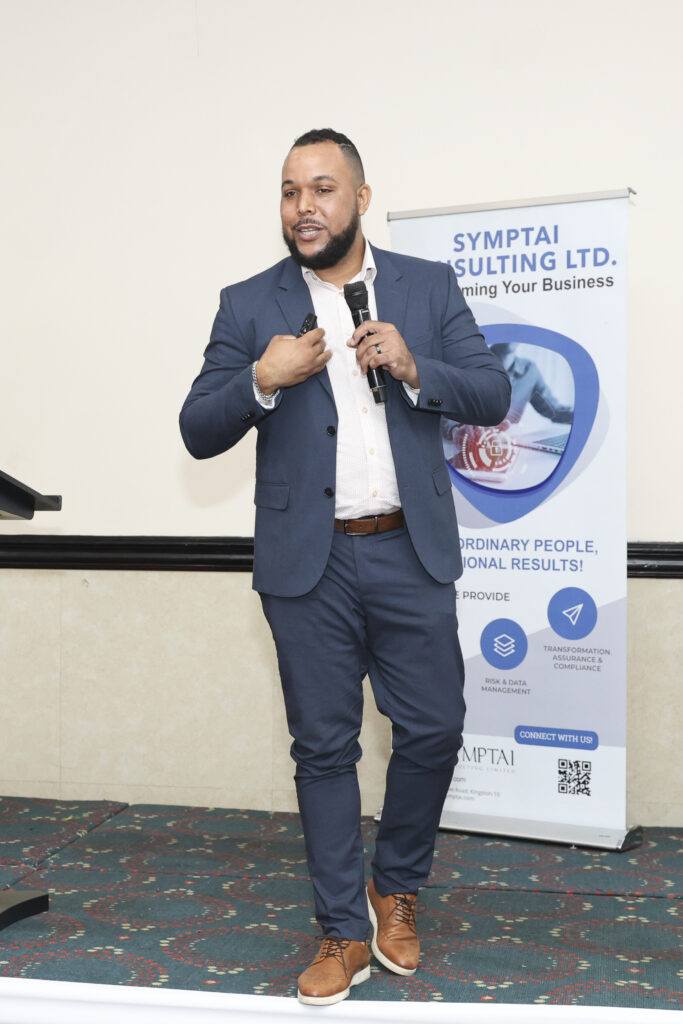
Symptai Director of Cyber and Information Security Rory Ebanks delivered a detailed presentation on why AML cannot be treated in isolation from cybersecurity or data privacy. He emphasised that breaches are not just technology issues, but also reflect organisational weaknesses.
Ebanks’s delivery underscored the urgency of implementing the 10 Cyber Resilience Principles introduced by the Bank of Jamaica and the Financial Services Commission. He further warned that the average cost of a data breach has climbed to nearly US$5 million globally, a 15 per cent increase over 2023.
In Jamaica alone, several high-profile ransomware attacks and data leaks, including one costing a public institution over US$231,000 for recovery, have highlighted the real and rising cost of delayed action.
Ebanks also shared that human error remains the most exploited vulnerability, with 74 per cent of successful attacks stemming from user missteps. These misjudgements include weak passwords, failure to detect phishing attempts or poor internal access controls. As such, he urged organisations to desist from viewing security as a tech problem and start treating it as a business-wide imperative.
Symptai assurance and compliance director Stuart Hylton, for his part, outlined how organisations can strengthen their AML programmes by adopting the cyber resilience principles as a foundation for privacy compliance. He noted that meeting regulatory obligations is as much about ensuring continuity and trust as it is about avoiding penalties.
“You cannot have strong AML systems and leave employee data exposed. A resilient compliance programme protects the organisation in all areas,” he said.

Symptai’s message received support from its technology partners at Alessa, with representation from Craig Lippmann, director of strategic partnerships and alliances, and Andrae Duhaney, product manager. Alessa, a provider of AML screening and transaction monitoring solutions, demonstrated how intelligent, cloud-based screening tools are revolutionising how institutions vet customers, detect red flags, and maintain compliance without the need for expansive IT infrastructure.
“Five of Jamaica’s eight commercial banks already use Alessa,” noted Cooper. “Through adoption and use of AI, the Cloud and a SaaS model, our AML solution now fits institutions with 500 customers. There is no excuse for not meeting the BOJ and FSC’s Cyber Resilience principles; to safeguard our Financial Services sector.”
Still, several financial institutions continue to fall short of the BOJ and FSC’s cyber resilience expectations. While large financial institutions may have the resources to identify and respond to threats swiftly, smaller institutions often operate without the same level of cybersecurity infrastructure. This discrepancy introduces risk to the broader financial system in Jamaica, raising questions about equity and access to digital protection.
With this in mind, Symptai continues to invest in education and collaboration as tools for resilience. The company will extend the conversation to the Jamaica Co-operative Credit Union League’s (JCCUL) upcoming conference in Montego Bay this month. Its directors hope to advance its support to institutions across the Caribbean in building strong, secure, and sustainable compliance ecosystems






Comments