
The best insurance policy crafted by man—the genius of Dr Nigel Clarke

Al Edwards / Our Today
administrator
Social media blew up last week as Jamaicans reacted with spontaneous gratitude and appreciation for the vision and foresight that led to the placement of Jamaica’s Catastrophe Bond, which was triggered by Hurricane Melissa and is expected to deliver J$24 billion to Jamaica at a time of profound need.
But the story of foresight and vision stretches beyond the Catastrophe Bond. And it is a story that must be told. It’s a story of how bold vision, exceptional forward thinking, and relentless policy execution become genius when they achieve their aim.
Hurricane Melissa will spell a downturn in the Jamaican economy, causing inflation, rising interest rates, unemployment and a need for funding for infrastructure repairs.
While the focus is on getting aid and donations, the Government will have to pivot soon to rehabilitating the economy. The macro-economic stability attained will be tested by the fury of Melissa, with at the very least, the first half of 2026 looking bleak for Jamaica.
Last year, I spoke with Dr Nigel Clarke at a social event at the home of the then Dominican Republic’s Ambassador to Jamaica, Angie Martinez. We managed to find a spot while the festivities were in high gear, and, in response to questions I asked him, he spoke with contagious passion about the importance of having a multilayered disaster risk financing framework with a Catastrophe Bond at the top layer to protect all that had been achieved, including the dramatic reduction in Jamaica’s debt-to-GDP ratio.
Disaster risk financing was indeed a central policy priority for former Minister Clarke, and one to which he devoted substantial energy, from his appointment as finance minister in March 2018, and a policy that he frequently spoke and wrote about while in office. So it wasn’t surprising that he sought to convert me into a ‘disaster risk financing’ believer that evening at Ambassador Martinez’s house!
With the devastating hit by Hurricane Melissa and the triggering of Jamaica’s disaster risk financing instruments, including the $24 billion catastrophe bond, I have had reason to reflect deeply on that conversation at the Ambassador’s house and to support my memory of that discussion by consulting Nigel Clarke’s posts on X over time as well as his policy memoir, “Footprints in the Sand – The Jamaican Economic Policymaking Experience 2016-2024”, a must read for policy enthusiasts, especially because it was written while he was in office.
He explained to me that night the source of his conviction. He also wrote about it in his policy memoir:
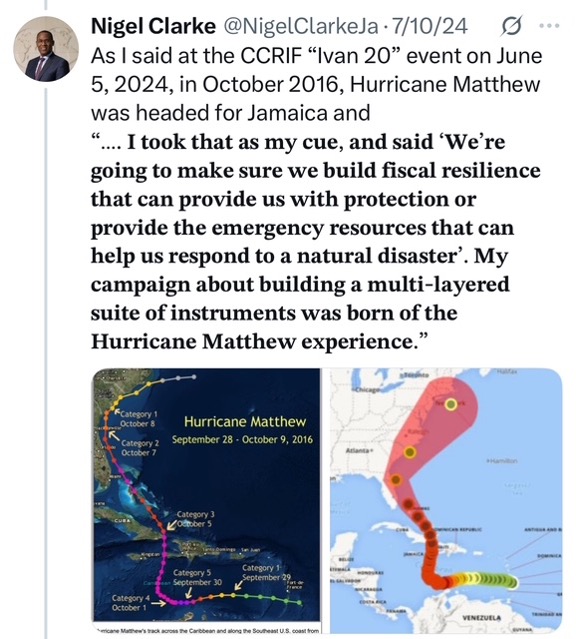
“Hurricane Matthew, the Category 5 beast was heading directly for Jamaica in October 2016 and, with only a few hours to go before it was to collide with Jamaica, Hurricane Matthew made a miraculous 90 degree turn, plundering over the passage between Jamaica and Hispaniola, leaving 700 people dead in Haiti and 50 dead in the United States with US$ billions of damage. It was a wakeup call for the then Plenipotentiary Ambassador of Economic Affairs, who realised, then, with horror, how bare the emergency coffers were, with a paltry J$94 million in the Contingencies Fund, and scarcely anything else. Had the Category 5 delivered the direct hit that it seemed to promise, Jamaica would have been unable to finance relief and recovery without heavy reliance on international handouts. As he tells it, he decided then that if he got the opportunity, he would ensure that Jamaica was not left so nakedly exposed to these risks.
Yes, we had the Caribbean Catastrophe Reinsurance Facility (“CCRIF”), but as Nigel has written about: “over 10 Hurricane seasons between 2007 and 2016, Jamaica was impacted by Hurricane Dean (2007), Tropical Storm Nicole (2008), Tropical Storm Gustav (2008), Hurricane Sandy(2012) and Hurricane Matthew (2016). Despite the impact of these five natural disasters Jamaica received no payout from the CCRIF.” As such, quite understandably, CCRIF sustained “cynical and negative press and even (some) parliamentarians (on both sides) lost faith in its potential.” So by 2018 when he became Minister, the Ministry of Finance had “faced pressure (from both sides of the aisle at the PAAC) to reduce or terminate the CCRIF”.
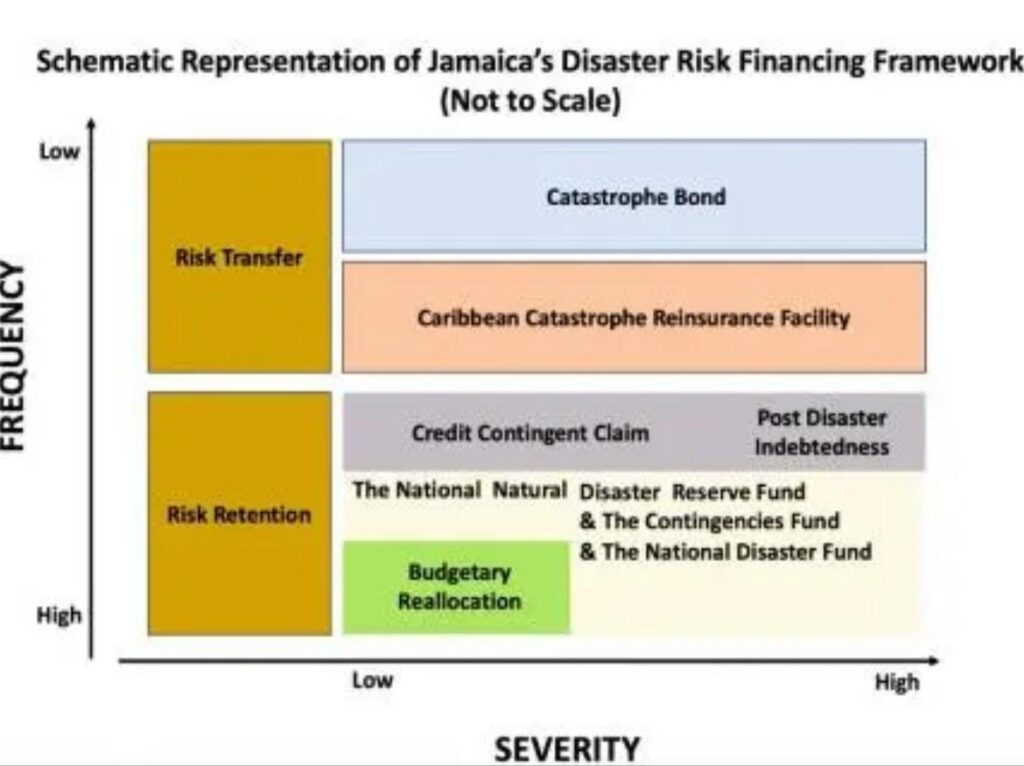
However, then Minister Clarke, after looking at the data and discussing with his technocrats and multilateral partners, reasoned that the problem wasn’t with the CCRIF per se. It was with the fact that, again quoting from his book, that, “…CCRIF had the unrealistic burden of covering the full breadth of disasters from low frequency to high frequency and from low intensity to high intensity”. The problem, in Clarke’s view, was that Jamaica had a product but not a framework. Therefore, as he wrote, “We did the opposite of what the critics suggested. We stuck with, and advocated for, the CCRIF, increased coverage limits and optimized parameters.” That optimization included continuing with a significantly lower “Attachment Point” than existed for several years after CCRIF’s inception (i.e. during the Dean, Gustav, Nicole and Sandy natural disaster events) and then putting in place a strategy and a framework to cover the range of low frequency and high frequency risks that could not be reasonably left to the CCRIF.
Over the next several years, the then Minister of Finance, studiously and cleverly foresaw this and put a cleverly well-crafted multi-layered disaster risk financing framework contingency in place, which some at the time dismissed.
The Contingencies Fund, provided by the Constitution, had a legislated cap of J$100m set in 1992 which was unchanged from this level for 27 years until Minister Clarke brought legislation to increase this cap from J$100 million to J$10 billion, capitalising the fund with $4 billion in 2019, within his first year in ministerial office, and adding another J$1 billion by 2022.
The recapitalised Contingencies Fund was then designated as one of the first layers in Jamaica’s multi-layered Disaster Risk Financing Framework. But the Contingencies Fund can be used for other unforeseen emergencies, and so, in 2024, the then-Minister Clarke addressed this through leading the policy development that created the National Natural Disaster Risk Fund (NNDRF).
I continued speaking with Dr Nigel Clarke at Angie Martinez’s residence that evening, with me drinking Appleton rum and coconut water. I raptly listened as he explained that the National Natural Disaster Risk Fund was set up to be the vehicle through which the Jamaican Government saves annually toward natural disasters, and it is also the vehicle to which disbursements from natural disaster instruments (like the Catastrophe Bond, the CCRIF facility and even the Credit Contingent Claims) will flow.
The NNDRF is now the repository of proceeds from all disaster risk instruments. In 2024/25, Nigel’s last year in office, the Government initiated NNDRF capitalisation with J$1 billion, while the legislation that created the NNDRF mandated that the GOJ contribute annually to this Fund. Disbursements from the NNDRF require the Ministry of Finance to come before parliament with a statement regarding the sums to be made available, thus ensuring transparency.
Another layer in the multi-layer approach consists of credit contingent instruments with the multilaterals, including the IDB and World Bank, which are triggered by natural disaster events above a certain threshold and from which approximately US$500m is immediately available without further approvals as a result of Hurricane Melissa. This layer is debt, of course, but it’s low-cost debt that doesn’t require preparation of an application at a time when Jamaica is least prepared to assemble the paperwork and fulfil the procedures required for loan approval, and when Jamaica’s key macro variables like GDP and tax revenues are both declining due to Hurricane Melissa. With foresight, as part of the disaster risk financing framework, these funds were applied for and approved in the good times for drawdown in the bad times.
But even this was not enough. Nigel was determined that Jamaica also needed catastrophic coverage that was not debt. He announced intentions to pursue a Catastrophe Bond as Jamaica’s top layer of natural disaster fiscal protection in his very first budget presentation in 2019. But then COVID intervened, interrupted and delayed these plans, but even COVID did not stop him.
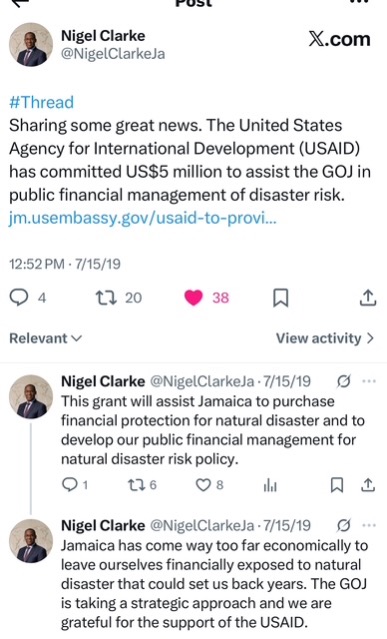
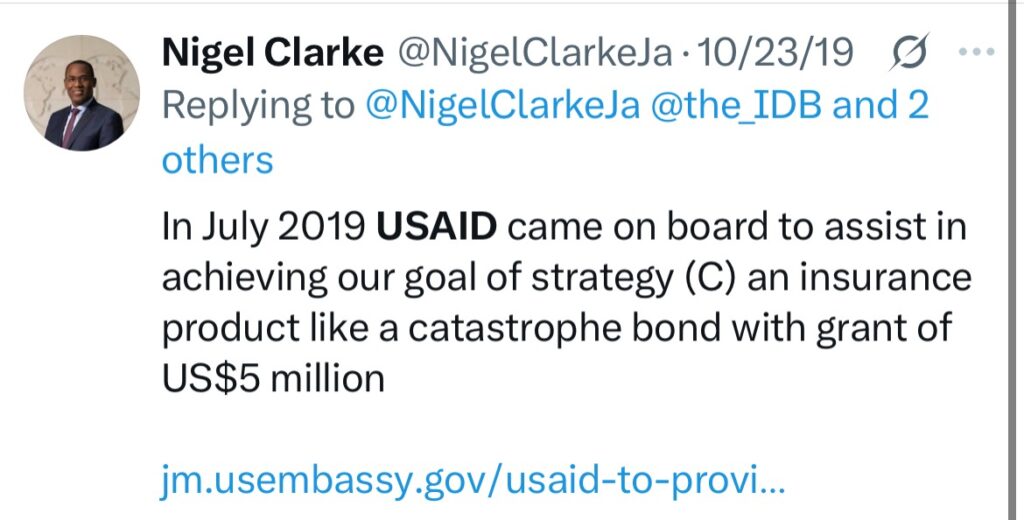
In the midst of the pandemic and with the country facing a combined health, financial and economic crisis, Jamaica’s first Catastrophe Bond was placed in international capital markets in 2021 with technical and balance sheet support from the World Bank. Former minister Clarke wrote and posted on X about Jamaica’s fiscal space being constrained at the time, and, having received the support of USAID in Jamaica, he travelled to Washington DC to convince USAID headquarters to support Jamaica in paying premiums for this first catastrophe bond.
He posted on X then that the Governments of the UK and Germany also supported Jamaica’s first cat bond’s premiums through a trust fund at the World Bank, which they fund. This nod of international support came after similar presentations in Washington. Jamaica therefore became the first small country in the world to independently sponsor a catastrophe bond.


At the time, many didn’t pay attention, but this move served to lighten the potential burden on the Jamaican treasury.
Jamaica’s catastrophe bond also globally introduced a new and important feature that had not been used before, anywhere in the world.* Dr Clarke wrote: “A catastrophe bond transfers catastrophic natural disaster risk from a sponsor ( Jamaica) to international capital market investors….Jamaica’s catastrophe bond globally pioneered the cat-in-a-grid” trigger approach which places a grid over Jamaica and surrounding waters, with each grid having a centralised air pressure threshold. Payout is triggered if a hurricane passes through a grid and has centralised air pressure ( as measured by the National Hurricane Centre in the United States) at or below the threshold for that grid. The size of payout is related to how many such grids are breached and the materiality of such breaches.”

The damage done by Hurricane Beryl last year was a portent of something more devastating to come. By then, Jamaica had a new catastrophe bond, placed in international markets in May 2024, and traded on the Hong Kong Exchange. This time, however, Jamaica undertook to finance the premiums on its own.


Dr Clarke continually stressed the importance of multi-layered disaster risk financing. In July 2024, as a guest columnist in the Gleaner, he penned an article entitled “ Building a Robust Disaster Risk Financing Framework”.
He wrote: “ There isn’t a better opportunity to further advance public understanding of this national policy than through the demonstration of its necessity, benefits and efficacy.”
How right he was. It doesn’t matter how much progress a small island state like Jamaica makes with its economy if that can literally be blown away every year or two by a climatic event.
Here’s the grim reality spelt out by Dr Clarke, and people should let this sink in.
“Jamaica faces a variety of natural disaster risks. As such, the disaster risk financing framework needs to be responsive to the full range of potential natural disaster outcomes-from low intensity to high intensity events and from low frequency to high frequency disasters. No one layer of protection can cover this range of possibilities. We need multiple layers. However, such a strategy is only effective if it is sustained over the long term and across successive political administrations.”
These natural disasters should not be politicised; rather, efforts to repair and restore should be part of national policy. For years, it has been discussed whether a part of government-generated revenue should be apportioned to address storms, flooding, hurricanes and such. That was blithely ignored. Now we are seeing more frequency and greater intensity of these events.
In other words, in times gone by, Jamaica would depend totally on the largesse of the main economies when it was struck by storms and hurricanes, unable to do much to help itself. Why? Because there was little foresight.
With this grid mechanism, Jamaica will qualify to be paid a substantial sum estimated at $24 billion (or US$150 million), considering Hurricane Melissa brought with her wind speeds of up to 185 miles per hour and air pressure well above 970mb.
Hurricane Melissa hit Jamaica on October 28, 2025, as a Category 5 storm. According to OCHA’ Centre for Humanitarian Data and the Humanitarian Data Exchange (HDX), Melissa recorded the highest estimated wind speed on land at landfall and the second-highest rainfall in Jamaica since 2000.
ACCU Weather said it tied in second place for the strongest ever Atlantic hurricane on record in terms of wind speed at landfall.
Thank God…. and thank Nigel that the catastrophe bond was in place.
But I am sure Nigel would want us to focus on the entire disaster risk financing framework as opposed to specific products. After all, after factoring in at least US$70 million or $11 billion from the CCRIF tropical cyclone policy (with more expected from the CCRIF excess rainfall policy) plus all the amounts mentioned earlier, Jamaica’s multi-layered disaster risk financing framework is poised to, in total, make as much as US$800m or J$128billion of immediately available, pre-approved liquidity available to the Government of Jamaica in the aftermath of Hurricane Melissa. Prior to 2018, when Nigel Clarke took the helm at the Ministry of Finance a minuscule, and certainly single-digit, fraction of this would have been available under similar circumstances of a Hurricane Melissa-like event. Nigel’s determined and dogged policy leadership, advocacy and execution on disaster risk financing have delivered massively for Jamaica.
These proceeds will help to alleviate the Government’s recovery efforts in the coming years, thus not placing an overwhelming burden on the economy.
“Jamaica has to continuously and consistently build on the existing DRF framework to ensure we are always fiscally prepared for the possibility of natural disaster events, “ concluded the former Minister of Finance, who is now holding the position of Deputy Managing Director of the IMF.
These words, as was clear to see last week, must be heeded. Jamaica is prone to these events, and it can’t just put its head in the sand and pray to God to spare us. Preparations must be made and funds set aside to mitigate the destruction and damage done to the country.
To have the best chance that this multi-layered disaster risk financing framework can survive into the future, Clarke and his team endured the long process of making it into national policy, with island-wide public consultations – in Half Way Tree, Sam Sharpe Square and beyond, among the people. The final policy was then tabled in parliament and approved by his fellow parliamentarians. As he said in 2024, “it is (now) the policy of the country on this subject. It is owned by all of us”


What Dr. Nigel Clarke stressed that evening in Norbrook was that it isn’t about simply accessing funds for rehabilitation but rather putting in place an entire intellectual framework designed to protect Jamaica by triggering the availability of resources in the event of a natural disaster. It’s not feasible to insure for the entirety of damage to public assets, but as Nigel explained to me that night, what you want is to have enough to cover the immediate emergency expenditures that can provide relief and finance recovery. The bulk of reconstruction can be staged and programmed over time.
As I write this article, Bloomberg is estimating the insured cost of Hurricane Melissa’s damage to property in Jamaica is as high as US$4.2 billion, a staggering sum.
Facing this bill, what I can say is thank God for Jamaica’s sophisticated, multi-layered disaster risk financing framework. It has achieved its aim, and that makes it an ingenious mechanism for the problem Jamaica faces. It must be continuously built upon by policymakers now and into the future.




Comments