Reading Time: 3minutes(Photo: American Academy of Orthopaedic Surgeons)
Do you see any changes on the surface of your neck?
Did you know that simply looking at your neck can provide a lifesaving or lifechanging clue to hidden health issues?
Here Our Today lists five subtle clues that may signal underlying issues.
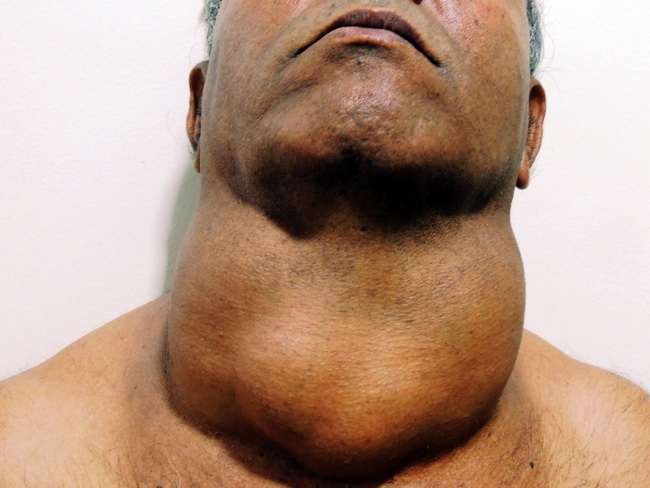
A patient with a multinodular thyroid goiter. (Photo: Webpathology.com)
A noticeable lump at the base of the neck This could imply a thyroid mass. Speaking to Good Housekeeping, According to otolaryngologist Dr Mark Varvares, “You really should not be able to see your thyroid gland at all. There’s not a lot of tissue there. Any lump you see low down on your neck, meaning to the left or right of the centre of your neck may represent a thyroid mass”. The vast majority inflicted with thyroid masses are benign. So, no need to start panicking, yet. However, the very large masses are better known as goiter. A goiter affects the swallowing process, it causes airway compression making the breathing process more difficult. A goiter reveals a more sever thyroid mass, indicating that it is time for a doctor’s visit.
A protruding vein A bulging vein looks almost like a really thick rope on the side of the neck, indicating that the jugular vein is in distress. A distressed jugular vein is caused by heart failure, pulmonary hypertension or a heart valve stenosis (pressure on your spinal cord or the nerves that go from your spinal cord to your muscles). Dr. Varvares said, “You should not be able to really see your veins, meaning they should not be very, very pronounced. If you have a distended neck vein, it could indicate superior vena cava syndrome. When accompanied by a mass on the upper chest, bulging veins could mean right-side heart failure because blood backs up into the veins.”
Florida man Charles Dion McDowell became the subject of ridicule online for having an enormous neck, but he might also be at risk for sleep apnea.
A broad neck If your neck is wide, meaning it measures up to 17 inches for a man and 16 inches for a woman, you are at high risk for sleep apnea (the cessation of breathing). Do you have a short neck and snore while sleeping? If yes, that means you migh have obstructive sleep apnea. Treatments such as a Continuous Positive Airway Pressure therapy (CPAP) machine or surgery will help solve the problem.
“Oral cancer related to HPV has increased an estimated 225 per cent over prior decades now. The first sign can be a lump in the neck right below the angle of the jaw. Usually you have no pain.”
Otolaryngologist Dr Mark Varvares
A distended lymph node under the angle of your jaw A swollen lymph node under the angle of the jaw could indicate an HPV-related cancer. According to Varvares, “Oral cancer related to HPV has increased an estimated 225 per cent over prior decades now. The first sign can be a lump in the neck right below the angle of the jaw. Usually you have no pain.” First of all, it is necessary and important to get vaccinated against HPV. Secondly, it is important to know that this kind of tumor typically starts in the mouth, but when the cancer spreads to the lymph nodes, it becomes visible in the neck.
(Photo: Johns Hopkins Medicine)
A throbbing pulse A throbbing pulse aligns with symptoms such as breathlessness or feeling faint. This could indicate a heart issue such as aortic insufficiency (the leaking of the aortic valve of the heart that causes blood to flow in the reverse direction from the aorta into the left ventricle). That means your aortic valve and the heart is working harder than it should be. Varvares advises that a visible neck pulse when the heart rate is resting is a red flag and the inflicted should call a doctor. He said: “That could also indicate a carotid artery tumor. You may also see a firm mass in the upper neck.”











Comments