Trinidad looking to grow its tourism product but crime and lack of infrastructure prove problematic

Al Edwards / Our Today
administrator
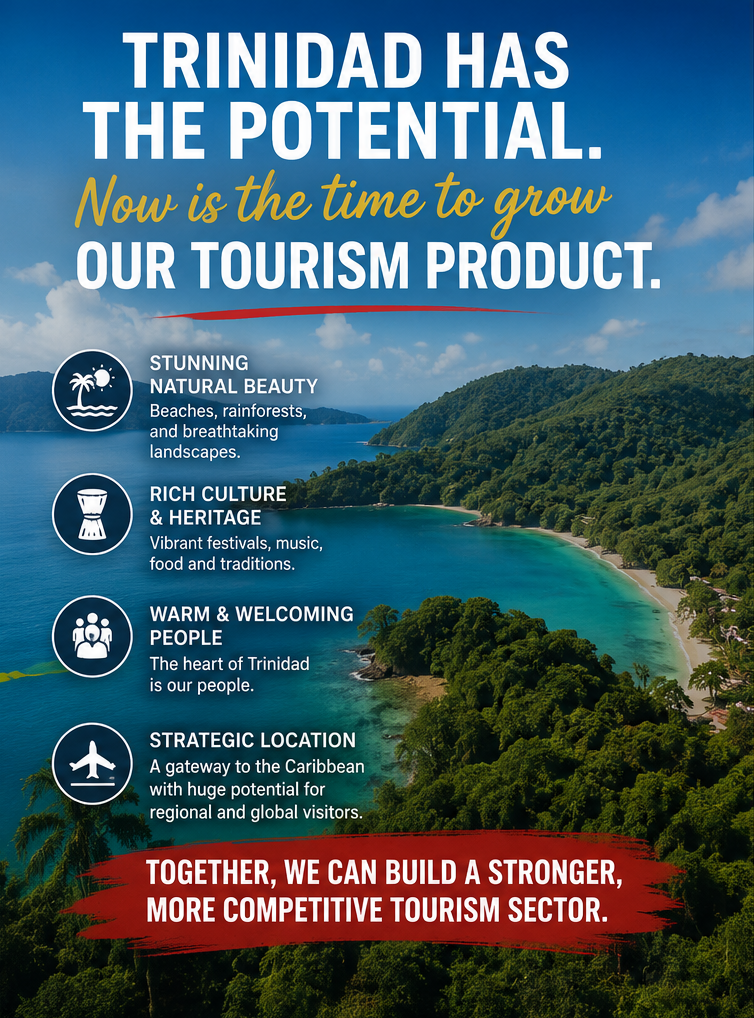
The twin island republic of Trinidad & Tobago notes the importance of getting more out of its tourism product but is handicapped by a number of constraints.
Trinidad&Tobago attracted around 450,000 tourists last year, an increase of 11 per cent over 2024’s figure. It also saw an uptick in flights to the destination with 9,206.
The country should be attracting around a million tourists a year but that will entail a commitment to the industry and putting in place infrastructure and marketing the country effectively.
“Tourism continues to drive economic momentum for Trinidad&Tobago. More visitors mean greater spending in hotels, transportation, restaurants and retail supporting businesses, strengthening GDP growth and increasing foreign exchange inflows. Tourism is not just about travel; it’s about economic opportunity and national growth,” wrote the Ministry of Trade, Investment and Tourism.
The country is renowned as a petrol-economy and has primarily focused on its oil and gas sector. However, there is a need to diversify given its foreign exchange problems. For decades, Trinidad & Tobago has not taken tourism too seriously, unlike other Caribbean countries like Jamaica, Barbados, St. Lucia and Antigua.
To become more competitive in this arena, Trinidad & Tobago will have to embark on a more aggressive marketing campaign of the destination and get more airlift into the country. It will also require more tourism infrastructure, including more restaurants, attractions, events etc.
Prime Minister Kamla Persad-Bissessar has struck up a strong alliance and friendship with President Trump and his administration. Perhaps she can call on her friend for help with tourism, getting more airlift and tourists from North America into the country.
A major impediment Trinidad & Tobago faces in attracting more visitors is the increase in crime and the imposition of States of Emergency orders. No one wants to leave the developed world to go into a crime-infested backwater.
Trinidad& Tobago now sees over 500 murders a year regularly and ranks seventh on the Country Crime Index ahead of Jamaica. Now the Government there is looking to introduce Zones of Special Operations to combat escalating crime.

In April of this year, the U.S. Embassy in Trinidad& Tobago issued a Department of State Travel Advisory telling Americans “ to reconsider travel to Trinidad & Tobago due to crime. There is also a heightened risk of terrorism. Some areas have an increased risk.”
Trinidad & Tobago can make more of an effort to attract visitors from around the region as well as tap into its Diaspora.
Currently undergoing a budget review, is the government willing to invest more in tourism? It can take heart in around 35,000 people flying into Trinidad & Tobago this year for carnival, which yielded spending of around US$71 million for the period.
Speaking about ramping up spending on tourism, the President of the Small Tourism Accommodation Owners of Trinidad and Tobago ( STAOTT) Denise Aleong said : “ I don’t know what to say in terms of having any anticipation. The arrivals have reduced during the State of Emergency Even though they claim this and claim that, that is not the reality on the ground.
Aleong has observed a greater reliance on domestic travellers using small accommodation providers rather than foreigners coming into the country to visit. With no regulations of Airbnb and small accommodation providers, bookings are difficult to trace.
The President of the Tourism Industry Association of Trinidad & Tobago ( TIATT), Lisa Shandilya says the country’s tourism sector must act faster if it is to be more competitive.
“The destinations that win are not necessarily the biggest. The winners are the most agile, the most connected, the most authentic and the most coordinated. We must protect both our international visitors and our legitimate tax-paying tourism stakeholders, ”Shandilya is reported to have said in the Trinidad & Tobago Guardian.






Comments