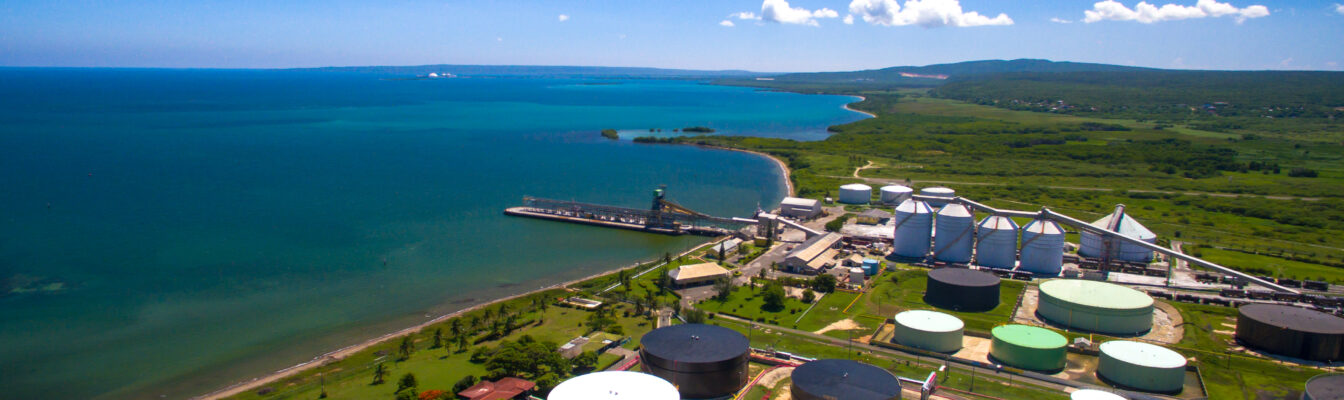
WI Petroleum Terminal growing revenues through more storage and throughput contracts

/ Our Today
administrator
Durrant Pate/ Contributor
Amid a marginal decline in revenues, West Indies Petroleum Terminal—which provides fuel for clients across the island (both large and small fuelling operations) and bunkering operations for cruise and cargo ships in port around Jamaica—is growing, diversifying its income streams through third-party storage and throughput contracts.
The company is seeing its diversification mix, reaping many benefits with storage fees earned from third parties growing to US$2.4 million or 43% of total storage fee revenues for the nine months, ended September 30, 2025, up from US$0.6 million or 10% in the prior year. At the same time, throughput revenues from 3rd parties as a percentage of total revenue increased from zero in 2024 to US$0.4 million or 6% of total revenue as at September 30, 2025.
The change in the revenue mix was a result of the acquisition of storage and throughput contracts from an oil supermajor. It is expected that revenues from 3rd parties will continue to increase this year from increased storage and throughput volumes. WI Petroleum Terminal, which is the latest publicly traded company, having done so last month, is boasting that it has the largest local gas station network on the island, and it is expected to see revenues grow with purchases of higher volumes.
For the combined three quarters of the current financial year, throughput volumes declined by 0.3 million barrels (mbbls) or 18.9%. This decline is expected to reverse in the 4th quarter, as the non-affiliated 3rd party throughput volumes will increase with the increase in volumes from the local affiliate of the supermajor. The company, which is the 105th listed company on the Jamaica Stock Exchange following its main market listing by introduction, notes that in prior years, throughput volumes were driven singularly by related parties, while in 2025, it is a mixture of throughput from related parties and non-affiliated 3rd parties.
Details of latest audited financials
Total revenue for the third quarter amounted to US$2.2 million, operating profit of US$0.9 million, earnings before interest, tax and depreciation (EBITDA) of US$1.35 million and net profit of US$0.65 million. For the combined three quarters, total revenues closed on US$6.5 million, operating profit of US$2.7 million, EBITA of US$4.1 million. There represents a marginal decline in year-to-date (YTD) revenues moving from US$6.7 million in 2024 to US$6.5 million for the period under review.
Year over year, quarterly total revenues declined by US$0.2 million or 6%, while YTD revenues declined by US$0.2 million or 3%. The company’s management expects this decline to reverse immediately with the acquisition of the waiver of the Common External Terrif (CET) for its major throughput client. “The decline in throughput volumes was partially offset by rate increases at the start of the year since rates for storage fees and throughput fees are benchmarked to the movement in the United States Consumer Price Index for the prior calendar year,” the management explains in its latest quarterly report to shareholders.
Year over year 3rd quarter net profit declined by US$0.2 million due to the decline in throughput volumes; YTD net profits were flat, and to note net finance costs declined by US$0.1 million due to the repayment of an amortised bond that existed in 2024. The performance was also factored by strong expenditure control, which kept expenses at the same level as the prior year.
Assets performance
Year-over-year, there was a decline in total non-current assets, due mainly to depreciation of plant & equipment and amortisation of Right-of-Use assets. There was an increase in total current assets, due to the timing of receipt of storage & throughput receivables, which are invoiced at the end of each month and paid by customers in the 1st week of the subsequent month.
Total current liabilities marginally declined to US$5.27 million for the period under review, down from US$5.56 million a year ago. These liabilities are driven in large part by an amount payable to the parent company. WI Petroleum Terminal was acquired in 2016, and the parent company, WI Petroleum, raised debt at the group level to modernise the plant and expand the storage capacity.
A part of this legacy debt was repaid in 2023 & 2024 from the proceeds of two bonds raised by the company. The intercompany debt is interest-free and has no fixed repayment terms.




Comments