CARICOM urged to embrace renewed vision for competitiveness and global readiness

/ Our Today
administrator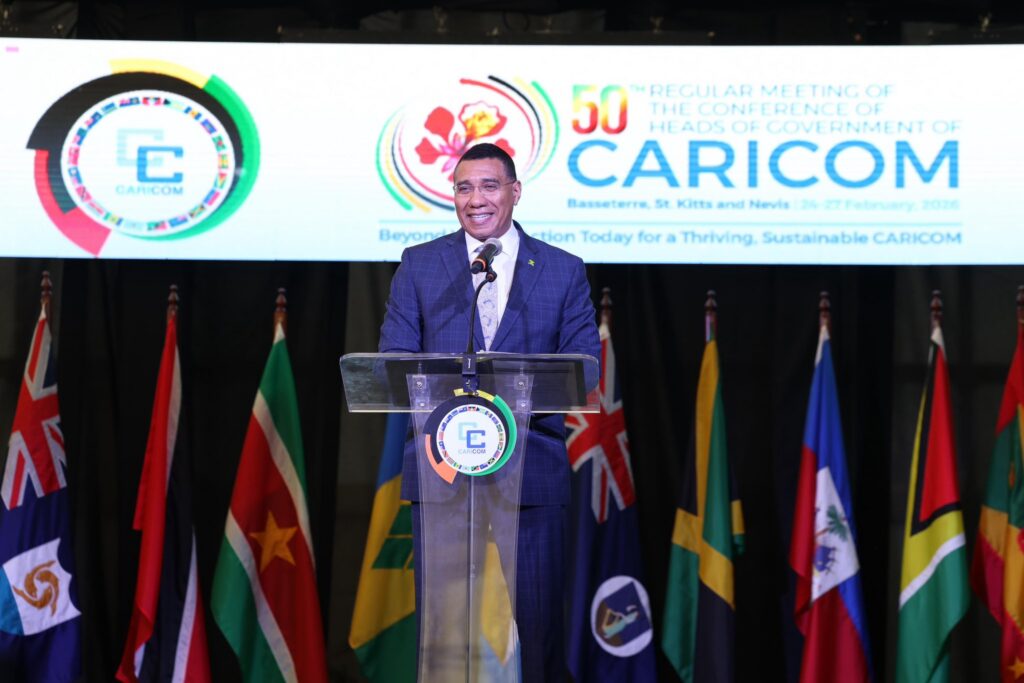
Prime Minister Dr Andrew Holness has urged Caribbean Community (CARICOM) Member States to embrace a renewed vision for the regional bloc—one that reflects the Caribbean’s identity and equips it to meet the demands of a new era.
He emphasised that this renewed vision must prioritise a competitiveness agenda, strengthen institutional readiness, and adopt a nuanced diplomatic posture.
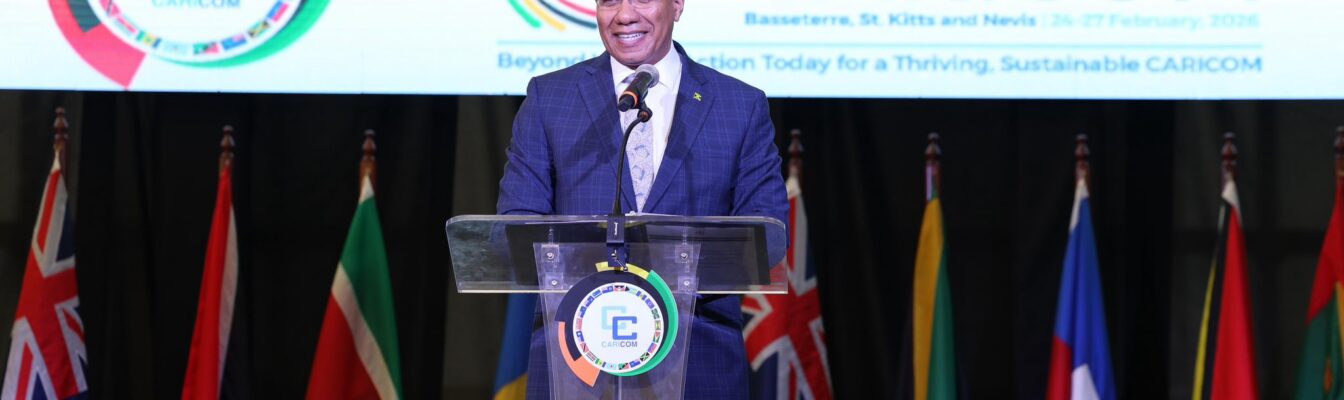
Dr Holness, the outgoing Chair of CARICOM, delivered his remarks during the opening ceremony for the 50th Regular Meeting of the Conference of Heads of Government, held in Basseterre, St Kitts and Nevis, on Tuesday, February 24.
He noted that while CARICOM is not a political union, it remains a powerful community of sovereign states, united by shared aspirations and shaped by overlapping, and at times converging, interests.
“We are not monolithic. We are not always going to be one group. But we are aligned in critical areas that matter most for our people—security, resilience in all forms, economic opportunity, and global relevance,” Dr Holness maintained.
He emphasised that as the region confronts a rapidly changing world, it must pursue a competitiveness agenda anchored in logistics, connectivity, digital and artificial intelligence (AI)-driven transformation, and clean energy, thus enabling economies to scale within the single market while allowing each State to advance its own development strategy.
Dr Holness further stressed that CARICOM must ensure its regional bodies are equipped to deliver clear priorities with professionalism and continuity, thereby inspiring confidence among global partners, while also reducing bureaucracy and increasing efficiency.
He charged that the regional bloc must also adopt “a nuanced diplomatic posture – one that recognises diversity among Member States not as fragmentation, but as a spectrum of strategic options that collectively enhance the region’s leverage”.
The prime minister emphasised that the region must speak with coherence, underscoring that unity does not demand uniformity.
“If we are to secure the future of our people, we must embrace both our shared identity and our sovereign dynamism. CARICOM endures because it adapts. It survives because we remain committed to the idea that small states can achieve big things when we work together,” he affirmed.
Dr Holness highlighted that CARICOM can play a constructive role, not as an ideological bloc but as a community of democratic states committed to cooperation, economic reform and social development. “This is not a moment for division in our community. It is a moment for maturity, for principled realism and, if we act wisely, for positive change in our hemisphere,” the prime minister stated.
He outlined that small states such as those in CARICOM risk marginalisation in a shifting geopolitical and economic landscape shaped by strategic rivalry, supply chain realignments, and a new era of trade protectionism, compounded by rapid technological disruptions driven by artificial intelligence.
At the same time, Dr Holness pointed out that Caribbean nations have opportunities to leapfrog in development, provided they act with deliberate intent.
He maintained that digital capability has become a core component of sovereignty, cautioning that states that fail to shape how technology is deployed will increasingly see their policy space defined by others.
Dr Holness said small states cannot afford to remain passive observers of these global shifts, stressing that “no single Caribbean State can build scale across these domains alone, but together we can pool talent, align standards, and develop digital public infrastructure to enhance productivity, inclusion and resilience”.
The prime minister stressed that success will, however, require deep engagement, information sharing, and collaboration among CARICOM nations. “For our part, Jamaica remains committed to a transparent fair, and rules-based multilateral trading system that is responsive to the vulnerabilities of small island developing states, while enabling us to compete and thrive in a tech-driven global economy,” Dr Holness stated.
He pointed out that the Caribbean Single Market and Economy (CSME) remains one of the region’s most vital instruments for transforming regional cooperation into tangible economic opportunity. “Our task is to make the single market work better by improving connectivity, aligning standards where it matters, easing the movement of skills, and building compatible digital and logistics infrastructure so that scale is possible, even for the smallest among us,” Dr Holness encouraged.
The prime minister emphasised that a more effective CSME is vital for strengthening resilience, enhancing productivity, and enabling Caribbean enterprises to succeed in an increasingly competitive global economy.
The 50th Regular Conference is being held from February 24 to 27, under the chairmanship of the Prime Minister of St Kitts and Nevis, Dr Terrance Drew.
The Conference is convened under the theme ‘Beyond Words: Action Today for a Thriving, Sustainable CARICOM’.




Comments