
Non-pharmaceutical interventions work in COVID-19 prevention-Bisasor

Juanique Tennant / Our Today

As the country’s positive COVID-19 cases continue to see a gradual decline, Chief Medical Officer in the Ministry of Health and Wellness, Dr Jacquiline Bisasor-McKenzie, is reminding citizens that non-pharmaceutical measures are effective in COVID-19 prevention and the onus is on everyone to enforce these on themselves.
Bisasor-McKenzie made the statement while making her presentation in the health ministry’s Thursday (June 17) evening’s COVID Conversation.
She stated: “Again, just to show the importance of non-pharmaceutical interventions, I just want to encourage persons that even though you may see general restrictions being released in the public generally, everybody should exercise their own personal responsibility to enforce some of these restrictions on themselves, on their families and the persons around them because we know that the non-pharmaceutical interventions work.”
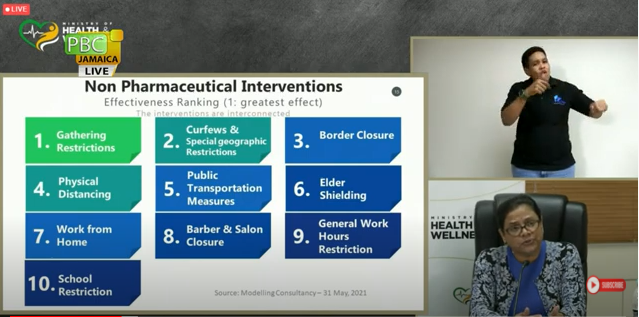
Bisasor-McKenzie noted that, at present, there are 10 non-pharmaceutical interventions that have proven effective as preventative measures against coronavirus infections and these are: gathering restrictions, curfews, border closures, physical distancing, public transportation measures, elder shielding, work from home, barber and salon closure, work hour restrictions and school restrictions.
In stating the different non-pharmaceutical interventions the medical officer highlighted that the gathering restrictions have been most effective in reducing the spread.
For this reason, she encouraged persons “to still avoid gatherings, to avoid any kind of parties or anything that there is a greater risk of exposure”.
On the matter of physical distancing Bisasor-McKenzie stated that it is “very very important that persons maintain physical distancing even when you are wearing masks”.
Similarly, she noted the importance of adhering to physical distancing and mask-wearing, even while taking public transportation.
As it relates to elder shielding, Bisasor-McKenzie reiterated that the elderly, alongside those with comorbidities, continue to be most at risk for severe coronavirus infections/outcomes and as such for these persons as much as it is possible they should avoid crowded situations.





Comments