
Ambraee Houslin | The Caribbean Investment Race: Jamaica cannot afford to move slowly

/ Our Today
administrator
A quiet but decisive shift is taking place across the Caribbean. Capital is moving. Investors are making decisions. Projects are being approved, financed, and built at a pace the region has not seen in decades. But the most important reality is this: the Caribbean is no longer rising together. Some economies are accelerating. Others risk being left behind.
For Jamaica, this is a defining moment.
The country is no longer competing only with global markets for investment. It is competing directly with its Caribbean neighbours — for the same capital, the same developers, the same investors, and the same opportunities. And in today’s environment, the race is not being won by the most stable economy. It is being won by the fastest.
The New Caribbean Reality: Speed Wins
Nowhere is the shift more dramatic than in Guyana. Since the start of oil production, the country has recorded economic growth averaging more than 25 per cent annually. Oil output has already crossed 600,000 barrels per day and is projected to exceed one million barrels within a few years. Foreign direct investment has surged beyond US$3 billion annually — a transformative level for a small economy.
The result is visible everywhere: highways, hotels, housing developments, office complexes, and large-scale infrastructure projects. Investors who once overlooked the Caribbean are now prioritising Guyana because projects move quickly and opportunities are expanding rapidly.

The Dominican Republic is competing just as aggressively, but with a different strategy. The country attracted approximately US$4.4 billion in foreign direct investment last year and has sustained economic growth of around 5 per cent annually for more than a decade. Its free-zone sector employs over 190,000 workers and generates more than US$8 billion in exports each year. At the same time, it welcomed more than 10 million visitors in 2025 — nearly double Jamaica’s arrivals.
Even smaller jurisdictions are moving decisively. The Cayman Islands host more than 100,000 registered companies and manage hundreds of billions of dollars in financial assets. Barbados has successfully positioned itself to attract high-income remote professionals and international wealth through targeted residency programmes.
The message across the region is clear: countries are not waiting for investment to come. They are competing for it — aggressively.
Jamaica’s Strength — and Its Risk
Jamaica enters this race with strong fundamentals. Public debt has fallen from nearly 147 per cent of GDP in 2013 to roughly 75 per cent today. Inflation has returned toward the Bank of Jamaica’s target range. The exchange rate has been relatively stable for two years. Tourism earnings exceed US$4 billion annually, and the BPO sector employs more than 50,000 people. The local financial system manages assets estimated at over J$2 trillion, providing significant domestic investment capacity.
By any measure, Jamaica is one of the most stable economies in the Caribbean.

But stability is no longer enough.
Investors today are not simply looking for safe economies. They are looking for environments where projects can be approved quickly, built efficiently, and operated competitively. And this is where Jamaica faces its greatest risk — not instability, but friction.
The Cost of Moving Slowly
Every delay has a cost. In an environment where global interest rates remain elevated and construction costs have risen by more than 20 per cent since 2020, time is now one of the most expensive inputs in any project.
Approval timelines that stretch for months or years increase financing costs, reduce project returns, and often push investors to look elsewhere. Developers comparing multiple Caribbean markets are increasingly asking a simple question: where can this project move fastest?

Energy costs add another layer of concern. Commercial electricity rates in Jamaica often exceed US$0.25 per kilowatt-hour, among the highest in the region. Logistics costs are elevated by congestion, particularly in Kingston, where traffic delays directly reduce business productivity.
Labour is becoming another constraint. Unemployment has fallen to approximately 4–5 per cent, the lowest level in Jamaica’s history. While this reflects a stronger economy, it also means companies expanding operations face tightening labour supply. Migration continues to remove skilled workers from healthcare, construction, engineering, and technical fields — sectors that are critical to investment-driven growth. None of these issues alone will stop investment. But together, they increase execution risk — and in today’s global environment, capital flows away from risk.
The Window That Will Not Stay Open
The timing makes this moment especially critical. Global companies are restructuring supply chains. Investors are looking for nearshore locations closer to North America. Diaspora capital is actively seeking opportunities in stable Caribbean markets.
Jamaica should be a natural beneficiary of these trends.
The country handles more than three million TEUs annually through its ports. Its proximity to the United States gives it a logistical advantage. Demand for modern commercial space, healthcare facilities, logistics infrastructure, and mixed-use developments is growing.
But opportunity has a shelf life.
If projects cannot move from concept to execution quickly, capital does not wait. It moves to markets where approvals are faster, infrastructure is ready, and timelines are predictable.
This Is Now a Regional Race
The Caribbean investment landscape has changed. Guyana is expanding at record speed. The Dominican Republic is scaling manufacturing and tourism. Financial centres are attracting global wealth and mobile professionals.
Growth is coming to the region — but it will not be evenly distributed.
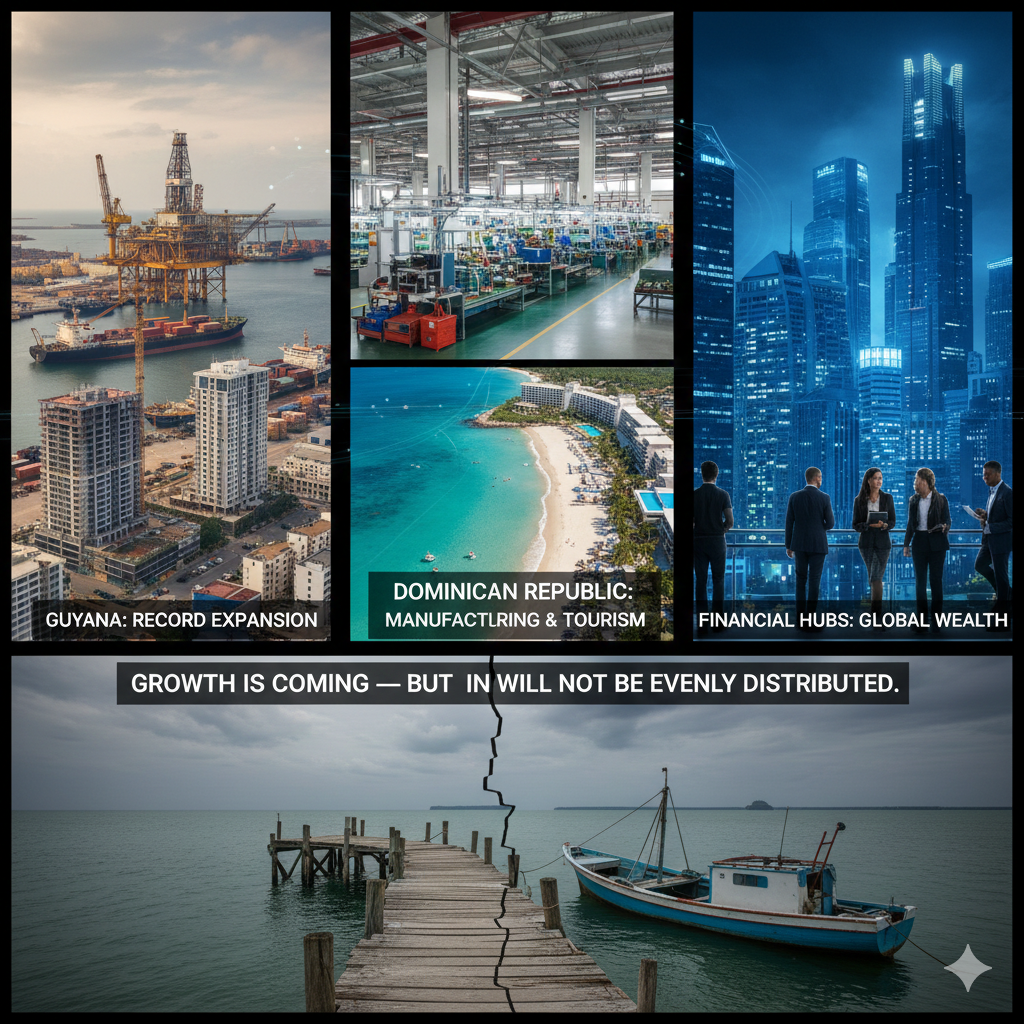
The countries that win this next phase will not necessarily be the largest or the most stable. They will be the ones that remove bottlenecks, streamline approvals, lower operating costs, and create environments where investors can move with confidence and speed.
The Bottom Line
Jamaica has done the hard work of stabilising its economy. Fiscal discipline, debt reduction, and monetary credibility have created a strong foundation. But foundations do not build growth on their own.
The next phase of economic expansion will depend on execution. Faster approvals. Modern infrastructure. Competitive energy solutions. Smarter urban planning. Stronger public-private coordination.
The Caribbean investment race is already underway.
Jamaica has the stability, the capital base, and the market confidence to compete. But in this new environment, the advantage belongs to the economies that move fastest.
The risk is no longer that Jamaica will fail. The real risk is that the region moves ahead — and Jamaica moves too slowly to keep up.
Ambraee Houslin is a Private Equity Strategist with a strong background in economics and statistics. He has extensive experience in investment banking, corporate finance, and investment research across Jamaica and the Caribbean region. His core expertise includes mergers and acquisitions, capital structuring, and executing complex transactions that drive growth and value creation. Ambraee has led and supported deals spanning strategic acquisitions, private credit facilities, and post-transaction integration strategies for high-impact sectors.




Comments