A hybrid system is preferable to the CCJ as Jamaica’s final appellate court-Champagne
Al Edwards / Our Today
administrator
The question of whether the Caribbean Court of Justice (CCJ) should be Jamaica’s final appellate court continues to lead to contentious debate and raises the issue of CARICOM countries becoming more self-reliant and demonstrating confidence in their own abilities.
Many attorneys in the Caribbean avidly studied the judgments of English legal luminaries like Lord Denning, Lord Bingham Lord Hailsham and Lord Scarman but very few can tell you about seminal judgements by Caribbean judges.
There are those that say the CCJ is too insular and that its leading judges are too familiar with the subject and personalities over which they have to make pronouncements upon. Better to have dispassionate judges who are removed from the culture and customs of the jurisdiction and can focus on the matter at hand without prejudice.
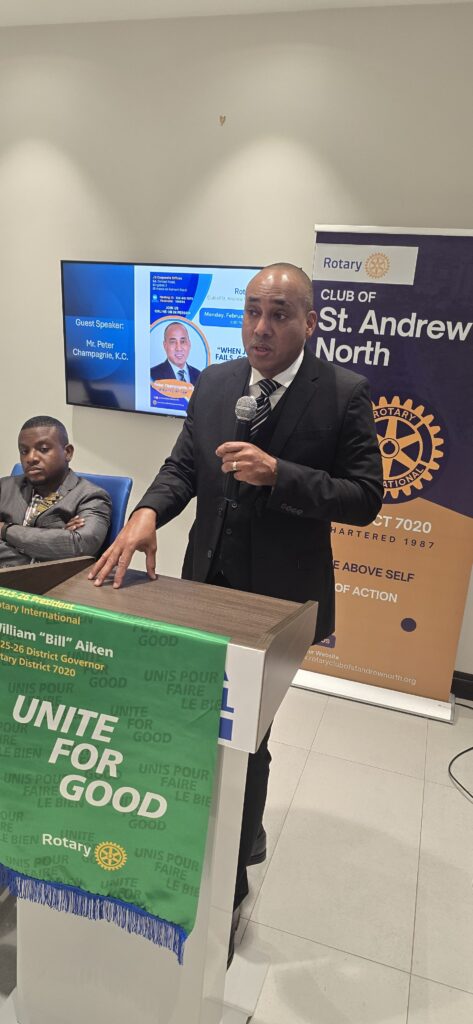
Leading attorney-at-law Peter Champaigne KC was the special guest speaker at last week’s Rotary Club of St Andrew North’s meeting entitled “When Justice Fails, Conflict Thrives” where he addressed the matter of the CCJ.
Champaigne is regarded as a standout criminal defence attorney and his services are well sort out. He is a keen observer of Jamaica’s justice system and attention is paid to his pronouncements.
Asked what his thoughts and views are on the CCJ being Jamaica’s final appellate court, the eminent lawyer replied: “ As much as we want to say we are integrated in the West Indies, we really are not. We tend to compete against each other and have this love/hate relationship.
“Part of my studies was in Barbados, and I saw it there and every now and again I still see it. At the same time, I have a problem, however, with having to go to our final court and being required to get a visa to go there.

“I think the CCJ has delivered some very good judgements, but there is still this element of mistrust, whether rightly so or not. It might come down to a situation where you have a final court of appeal in Jamaica beyond the Court of Appeal, where you have composite members, some of whom are not from Jamaica. You can have judges from New Zealand and Australia for example.”
This is a very perspicuous approach and removes the element of insularity and parochialism.
Champaigne’s view here is instructive against the background of a 1993 paper entitled “ A Time for Action: The Report of the West Indian Commission.” It recommended the establishment of the Caribbean Court of Justice with dual jurisdiction- appellate and original. In its conclusion, the West Indies Commission stated: “ There is now another reason for establishing a court of high authority in the Region, and that is the process of integration itself. Integration in its broadest economic sense, involving a single CARICOM market, monetary union, the movement of capital and labour and goods and functional cooperation in a multiplicity of fields- must have the underpinning of community law.

“Integration rests on rights and duties; it requires the support of the rule of law applied regionally and uniformly. A CARICOM Supreme Court interpreting the Treaty of Chaguaremas, resolving disputes arising under it, including disputes between Government parties to the Treaty declaring and enforcing Community law, interpreting the Charter of Civil Society- all by way of the exercise of an original jurisdiction is absolutely essential to the integration process.”
This integration process goes to the heart of what Champaigne has to say about the efficacy of the CCJ.
Returning to his call for a blend, a hybrid system, Champaigne further explained: “ We can have that kind of blend until we have that necessary maturity and confidence in ourselves. You have that competition among Caribbean countries and you hear it all the time-“ Oh, you are from the small island” and “ you people from Jamaica”. It is still there despite this talk about regional integration.
That is essentially my view on it and I know it may not be the popular view but there it is.”
The special guest speaker at the Rotary Club of North St. Andrew meeting held at the JN Conference Suites on Oxford Road in Kingston went on to add that his view stems from time spent in Belize where he had interactions with people across the region.
“We tend to beat up on ourselves a lot in Jamaica. I have to say we in Jamaica are far ahead of many Caribbean countries in terms of our skillsets, in terms of our system of justice and in terms of the healthiness of our democracy.
“So I am not so eager to necessarily embrace the CCJ as some people would like it. I think there ought to be a hybrid system until we are truly fully integrated,” said Peter Champaigne KC.




Comments