
Douglas Levermore | Systemise or Suffer: Why Businesses Fail Without Repeatable Thinking

/ Our Today
administrator
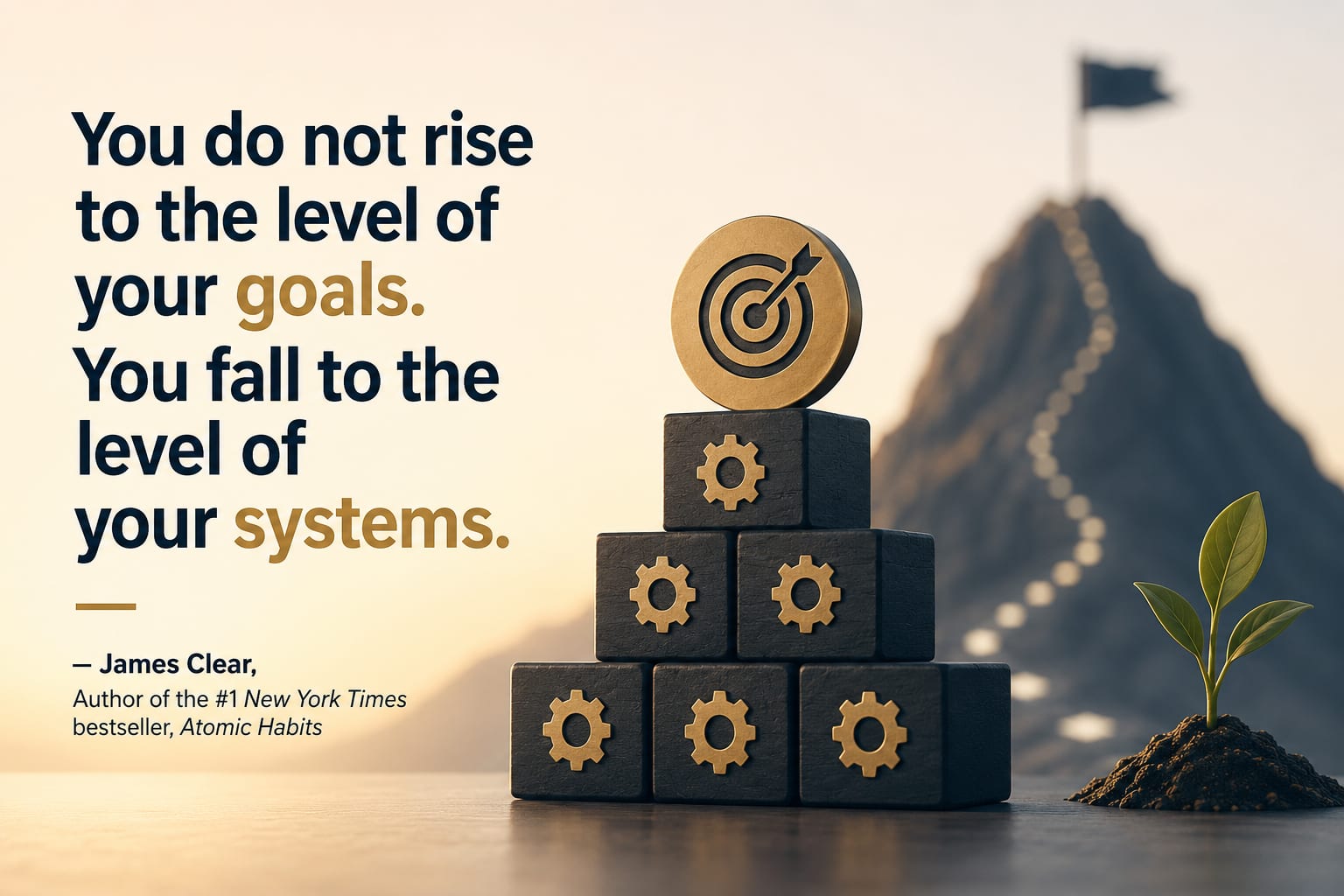
“You do not rise to the level of your goals. You fall to the level of your systems.”
— James Clear, Author of the #1 New York Times bestseller, Atomic Habits
In late 2025, several high-profile technology and services firms announced layoffs and restructuring despite reporting strong topline revenue growth earlier in the year.
Earnings calls revealed a familiar pattern: sales were healthy, demand was visible, yet cash flow was erratic, margins unstable, and execution uneven. Analysts were quick to cite “market uncertainty,” but internal reviews told a quieter story—operations dependent on a few overextended individuals, informal processes, and institutional knowledge locked inside people rather than systems.
The lesson was not new. Chaos is expensive. Systems create survival.
Picture a customer service representative at a bank who receives a frantic call from an elderly customer convinced that someone is draining money from her account. If there is no clear escalation path, the representative may hesitate, transfer the call aimlessly, or rely on personal judgment while precious minutes slip away. But in a well-designed organisation, nobody has to invent the response under pressure. The representative follows a repeatable process: verify the customer’s identity, freeze vulnerable accounts, alert the fraud team, notify a supervisor, document the incident, and reassure the customer about the next steps.

The situation may be different tomorrow—a stolen credit card, a phishing scam, or suspicious online activity—but the thinking remains consistent. The process does not replace human judgment; it gives people a reliable foundation on which to exercise it. That is what mature organisations understand. When stress is highest, and emotions are running hottest, people perform best when they do not have to guess who to call, what to do next, or who is responsible. Good systems turn panic into purposeful action.
Many businesses, particularly founder-led and growth-stage firms, operate on heroics instead of repeatable thinking. The organisation “works” because someone remembers, someone follows up, someone stays late, someone improvises. Flexibility is celebrated. Hustle is rewarded. But over time, the cost compounds. When outcomes depend on individuals rather than process, performance becomes fragile. Absences hurt. Growth strains. Errors multiply.
Research consistently confirms this. A 2017 study in Harvard Business Review examining operational failures across mid-sized firms found that companies relying heavily on informal processes experienced significantly higher variance in performance and were more vulnerable to disruption than peers with standardised workflows—even when those workflows were imperfect. Consistency, not brilliance, drove resilience.
Founders often confuse flexibility with freedom. In the early days, improvisation feels empowering. Decisions are fast. Roles are fluid. Problems are solved in real time. But as scale increases, flexibility without structure becomes dependency. The business does not adapt; it reacts. Every issue requires executive attention. Every absence creates delay. The organisation becomes a collection of exceptions rather than a system.
Consultants, when effective, succeed precisely because they reverse this dynamic. Their value is not superior intelligence, but translation. They take intuition and turn it into process. They convert “how we usually do it” into “how it is done.” Systemisation is not bureaucracy—it is resilience codified.
The cost of informal processes is well documented. Research from the MIT Sloan Management Review shows that organisations with low process maturity suffer higher error rates, longer cycle times, and greater employee burnout. Informality shifts cognitive load onto people. Systems absorb that load. When processes are unclear, individuals must constantly decide, remember, and compensate. That effort is invisible on financial statements—but it shows up in turnover, missed deadlines, and cash volatility.
Accounts receivable provides a particularly stark example. Many firms treat AR as a collections problem rather than a system problem. Invoices go out late. Terms are ambiguous. Disputes are discovered weeks after billing. Follow-up depends on individual persistence. Sales incentives reward closing deals, not collectability. Finance waits. Cash becomes unpredictable.
“If revenue is predictable but cash is not, the system is broken.”
Academic research supports this framing. A study published in The Journal of Corporate Finance found that firms with standardised credit policies, invoicing schedules, and escalation protocols had materially lower days sales outstanding (DSO) and less earnings volatility than firms that relied on ad hoc collections—even controlling for industry and size. Cash discipline was not a function of aggressiveness, but design.
The same logic appears at a global scale. Assessments from multilateral development agencies provide a parallel illustration of what happens when systems are rushed or ignored. Reviews of rapid digital public-service rollouts across parts of Africa, South Asia, and Latin America—particularly in cash-transfer, digital ID, and social-protection programs supported by the World Bank and the United Nations Development Programme—found that initiatives launched under political and donor pressure often underperformed those introduced more deliberately.
Programs optimised for speed failed to account for informal economies, shared devices, low digital literacy, gendered access to technology, and local trust dynamics. By contrast, pilots that invested months in observing beneficiary behaviour, intermediaries, and failure modes before scaling showed higher uptake, lower fraud, and stronger legitimacy. The conclusion echoed across regions: in complex human systems, haste substitutes optics for understanding—and the failures cost more to fix than the time originally “saved.”
Systemisation reduces dependency on individuals by making performance portable. When knowledge is embedded in process, the organisation survives turnover. When decision rules are explicit, judgment improves. When escalation paths are clear, risks surface earlier. This is not rigidity. Well-designed systems allow flexibility at the edges precisely because the core is stable.
Behavioural science reinforces the point. Studies on cognitive load demonstrate that people perform worse when forced to manage ambiguity continuously. Systems reduce decision fatigue. They free attention for judgment rather than memory. As psychologist Daniel Kahneman’s work on decision-making shows, predictable structures reduce error by limiting reliance on fast, intuitive thinking in environments where consistency matters.
Businesses do not fail because people are incapable. They fail because too much depends on them. Heroics mask fragility—until the hero is unavailable, burned out, or gone.
Systemisation is not an admission of weakness. It is an acknowledgement of reality. Markets are volatile. People are fallible. Growth amplifies cracks. Organisations that endure are not the most creative or charismatic, but the most repeatable.
Chaos feels energetic. Systems feel quiet. But when pressure arrives, only one of them holds.
Douglas Martin Levermore, MBA, JP, is an independent management consultant and the founding Executive Director of Jamaica’s Public Investment Management Secretariat (PIMSEC)—the government unit established to strengthen project appraisal, fiscal discipline, and oversight of public investment, now known as the Public Investment Appraisal Branch (PIAB) within the Ministry of Finance and the Public Service. He also serves as a FINRA arbitrator and a commissioned Notary Public in the Commonwealth of Virginia. He is available for select international consulting, advisory, keynote speaking, and project-based engagements and may be contacted at [email protected]. These reflections are written with the generous gift of a stranger whose kindness gave him more time—a tribute to the organ donor whose legacy lives on through every word.





Comments