
Jamaica’s three-day lockdowns see drop in COVID spread but active cases at highest level ever

Gavin Riley / Our Today
administrator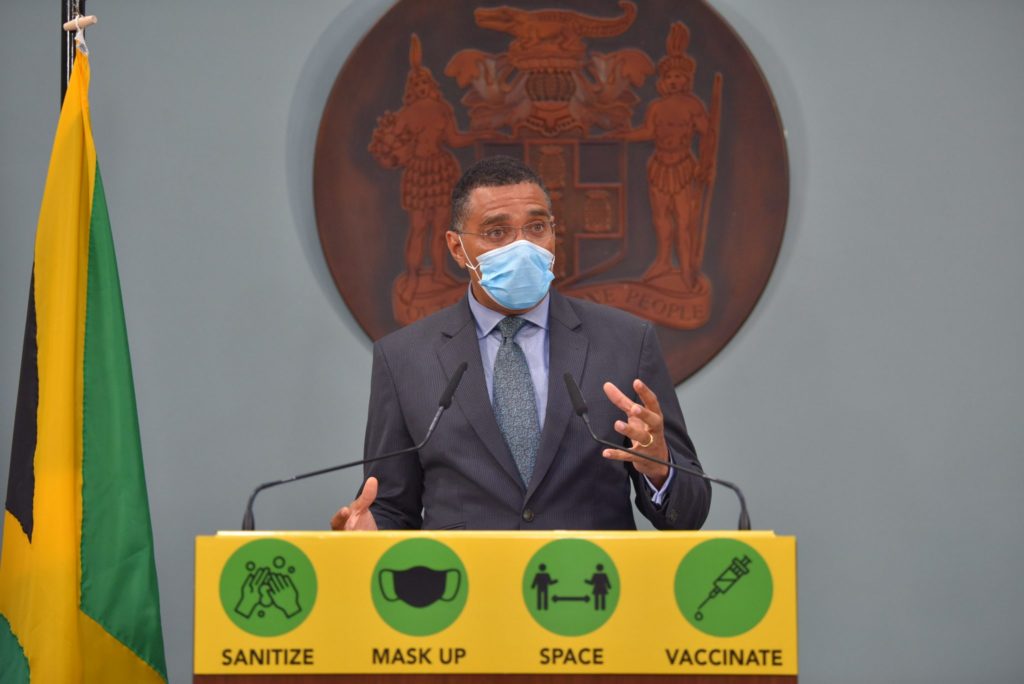
The period of lockdowns announced by Prime Minister Andrew Holness last month has had some effect in cooling the fevered coronavirus (COVID-19) outbreak that swept across Jamaica.
Our Today, analysing data released by the Ministry of Health and Wellness, noted that over the initial 22-day period under which the lockdowns were imposed (August 22 to September 13), the island confirmed 14,275 new cases.
Fuelled by the Delta variant, the country’s cumulative caseload continued to increase—from 63,464 to 76,987, before the three-day no-movement restrictions were later modified to Sundays only.
According to health ministry data, Jamaica confirmed 674.13 new cases on average daily, with a new record set on August 28 (929 new cases) eclipsing the country’s previous peak in March (878 new infections).
Additionally, the positivity rate, which gauges the number of confirmed COVID-19 cases against samples tested, was marked at an average of 42.4 per cent daily. The positivity rate fluctuated between an all-time high of 54 per cent and 28.4 per cent during the 22-day review period.
The difference between March and August, however, is the seeming difference in how the Alpha variant, which was the dominant strain that spread throughout the country, reacted to lockdown measures by the Holness Administration.
The success of the three-weekend lockdowns in March 2021 has all but shrivelled in the face of the more virulent and transmissible Delta variant, even with similar levels of compliance from the Jamaican public.
As evidenced in the data, 6,355 new COVID-19 cases were confirmed in the first two weeks after the discontinuation of the three-day lockdowns.
On average, Jamaica confirmed 453.93 cases daily between September 14 and September 27, while the positivity rate fell close to 12 percentage points, to a 30.2 per cent average daily.
It should also be noted that Jamaica’s active cases today have never been higher than at any other point of its national response to the pandemic.
At the country’s previous peak on May 1, Jamaica registered 23,845 active cases. As of September 27, the island’s active case count, roughly two weeks after lockdown measures were relaxed, sits at a staggering 28,897 infections—an 82.5 per cent increase.
Back on August 19, when Holness first announced the tighter restrictions, the prime minister declared that the health ministry’s prerogative was to “effectively break the cycle of transmission.”
Based on the seven-day average, case fatality and case reproductive rates then, the Holness Administration warned that the country could be staring down 1,402 daily cases and 226 weekly deaths by September 1.
Another worst-case scenario of 193 daily hospital admissions and 1,064 weekly hospitalisations was presented for September 4, should the outbreak continue at the rate registered on August 17.
The government could effectively claim its lockdown measures were a success given the average weekly deaths only rising to a high of 16 and hospitalisations, which climbed to 739 on August 27, currently sitting at 608 a month later.





Comments